Godard dedicated Breathless (1960) to Monogram Pictures, and one look at an interminable John Wayne feature from that studio in the thirties is enough to understand why. In the 1966 diary that he kept while shooting Made in U.S.A. (1966) and Deux ou trois choses que je sais d’elle (1967), Godard wondered: ‘Mystery and fascination of this American cinema. How can I hate MacNamara and adore Take the High Ground [Richard Brooks, 1953], hate John Wayne upholding Goldwater and love him tenderly when abruptly he takes Natalie Wood into his arms in the next-to-last reel of The Searchers [John Ford, 1956]?’ [1] Yet JLG knew the answer to his own paradox. The tenderness derives, in part, from sensing that Wayne, artistically, was born out of the cinema of poverty, the cinema of the B westerns. Here is the Wayne contradiction which compels us today: soft and hard, cancelling the two out. Right and left, forcing the viewer to come up with new terms for (political) Form. How to be in two places at once. Godard, master dialectician of the cinema, would learn this well from John Wayne. Wayne himself would learn from his apprenticeship for ten years as a low-paid singing cowboy.
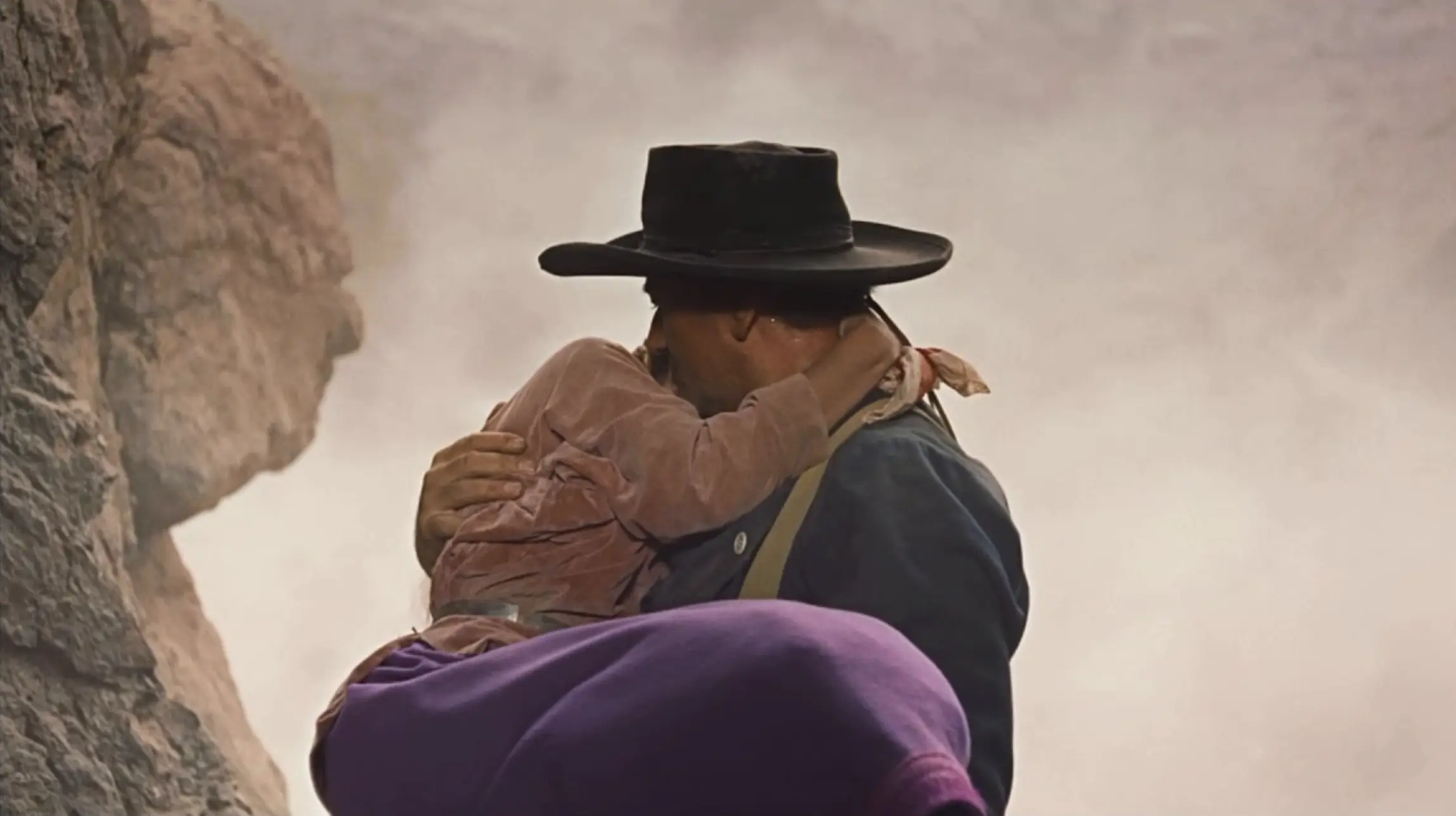
The Searchers (John Ford, 1956)
Was one of the Monogram pictures seen by Godard The Man from Utah, a 1934 cheapie from ‘Lone Star Productions’, the westerns-only division of Monogram? Here, JW is a singing cowboy. (Clearly dubbed. That’s fine. Who needs direct sound. The Italians didn’t need it to make their films, so why should we?) JW rides into town, seeking a job (it’s the Great Depression). He saunters to the marshal’s office. On the door, there’s a flier: men wanted to fight forest fires. JW opens his wallet: there is only one coin in it. He flips it heads or tails: will he, won’t he. This is the purest of signifiers for the cinema of poverty in 1934, bolstered by the eerie silence that is a hallmark of this middle-peak period of newfangled talkies made on the cheap (from Capra’s It Happened One Night to Fernando de Fuentes’s Prisoner 13). A single coin in an empty man-purse, empty so that the coin does not have to (in obsequious tribute to the bastard-god of Realism) jangle against flippant products of the day: cigarette cases, matchbooks, compacts. This single coin is enough to establish, proudly, the roots of poverty. The scene is smooth as a monk’s tonsure, like (but only like) Rossellini or Bresson — right down to the sensual close-up of Wayne’s hands as he fingers the coin, which looks less like an American nickel and dime and more like a Caesar-stamped lumpy treasure from the days of Gay Rome.
Note that I emphasized saunter. Wayne on Poverty Row is a digressive type, not as efficient as he would become under Daddy Ford’s eye. With his lean actorly gestures, he mastered that mixed Godardian tendresse, a mastery that would grant him J. Edgar’s ear, and a permanently welcome seat in the YouTube comment sections of nostalgic MAGA boomers and their progeny. Gravity bends to the rule of Wayne. The hands will always fumblingly caress the brim of the singing cowboy’s hat when he takes it off in the presence of a Lady. A bashful grin, then a galumphing stare up-down-up-down from eyes and lips, so flirty yet like a soft papa-bear. Wayne’s default in group scenes is to remain standing over little ladies and mustachioed big-boss villains, the better so that his 6’4’’ frame can assert its casual dominance, and gently ease his body into a contrapposto. One Wayne leg locks straight, bearing his body’s weight, allowing the second Wayne leg to loosen up. The Godardian contradiction, the push-pull that makes him thorny for anyone at either pole of the classical political spectrum to engage, is physicalized in the Waynian contrapposto, a pose evoking a bygone Classical pose. The Waynian contrapposto is founded upon Loss; it is primed to appeal to the Left-wing aesthete fine-tuned to the shape and feel of loss, and the Right-wing embalmer who builds a megachurch to it. Wayne deploys the contrapposto in all his major films, from Stagecoach (1939) to The Shootist (1976), from The Quiet Man (1952) to Hatari (1962). It carries the weight of history, of Greece, of a rigorous shapefulness that each new modernity is always trying to somehow unconsciously salvage back to human eyes, like the Etruscan statue in La Chimera (2024). And the contrapposto, properly deployed, works to make his scene partner, whether Lauren Bacall or Maureen O’Hara, Red Buttons or Ward Bond, relax in Wayne’s presence: he will take care of the scene, he will anchor it, and therefore we need not do so much because he’s compelling us to simplify, simplify, simplify.
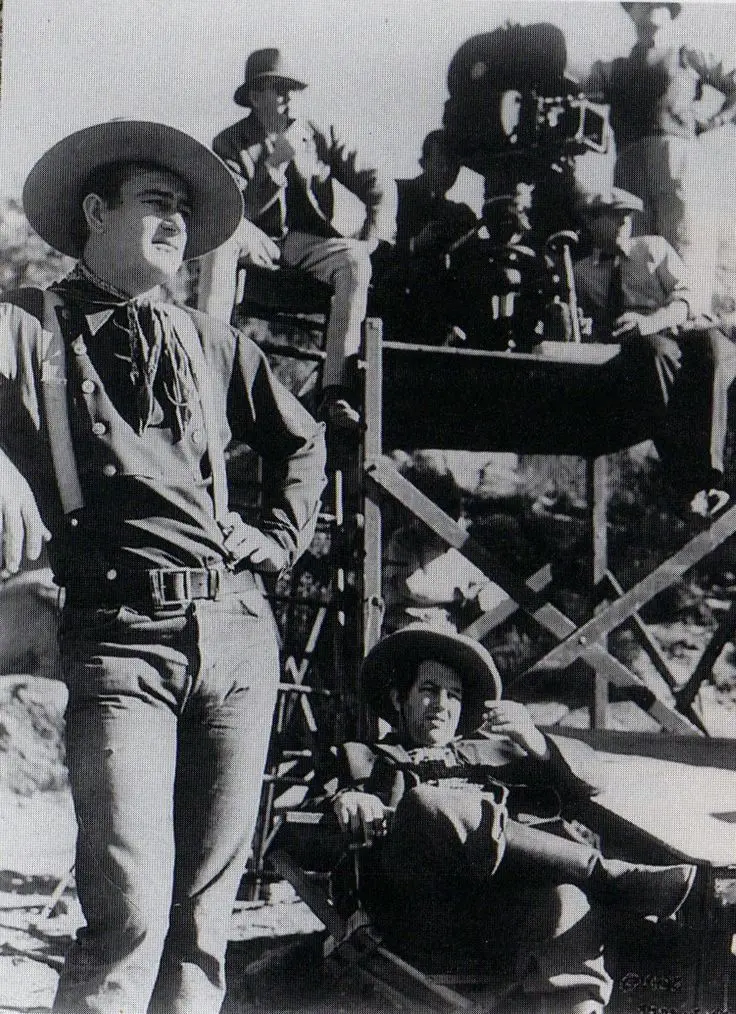
John Wayne behind the scenes of Stagecoach (John Ford, 1939)
Luis Buñuel, c. 1963: ‘For a culture to survive, it needs cannons. It needs power: economic power, military power. Look at Spain: its armed forces are outdated and in shambles and Spanish culture is unknown. Today’s great culture is the United States, with its battleships and rockets. Everyone knows Hemingway; he’s a genius worldwide. If Hemingway were Spanish, no one would have ever heard of him. Taken on his own, he is nothing special. But since he’s American…’ [2]
One American in these Z westerns resists the Waynian contrapposto: Louise Brooks. In Overland Stage Raiders (1938), Brooks acts out her last great role outside her silent masterworks with G.W. Pabst, in which she caused the greatest revolution in acting and sheer being on the screen since Chaplin’s Woman of Paris (1923). In the 1938 film, Brooks plays opposite Wayne as the dewy-eyed love interest, indistinguishable from about a hundred other actresses who were then trying to make it into Hollywood at the time. When I say ‘great’, I should say that Brooks’s greatness, unlike her silent films, is against her own will. Clearly, this disgraceful role is beneath her. It’s a job for a meager paycheck, like it is for Wayne — but ascending Wayne will go on to star in Stagecoach (1939), while descending Brooks will languish in poverty and obscurity in New York. Her role in Overland Stage Raiders was her last before she lobbed the final middle finger at Hollywood and retired to write her memoirs. Wayne works up his contrapposto, hey-little-lady act on her. It doesn’t work. She needs more money to act more convincingly. Rightly so. These money men will get only the bare minimum from Miss Louise Brooks, if that. She goes through the motions of being seduced by Wayne the statue as if she were Dominique Sanda in Une femme douce (1969), a coldfish tabula rasa for moviegoers in Elkader, Iowa to scrawl on as they please. As her parting act, she reveals the constructed nature of Wayne, and therefore of the nation and the assembly-line money-system that used then discarded her, with her unimpressed nothingness. Warhol would tap into this nothingness and make it the basis of his own artistic revolution. That nothingness is star-bred, Hollywood-bred, factory-bred. John Wayne was only too happy to be a factory worker. Louise Brooks wrote.
Wayne, Hollywood’s actorly Hemingway, is nothing special — despite what Joan Didion’s mash notes to the hunky Duke would suggest: He’ll build her a house ‘at the bend in the river where the cottonwoods grow’. [3] Fuck the cottonwoods. These cheap-o, insignificant Z westerns are the real Wayne legacy. They’re the soil out of which we get both the Wayne who spanks a grown woman over his knee to knock some sense into her and the Wayne who picks up the same woman to take her to safety, whisks her into comfort, away from the consequences of imperialist modernity. He is the cause of chaos and the savior of those who fall into the self-made maw of chaos. These films are, if nothing else, honest: action, go-go-go, pure cinematographic writing in the order of Bresson’s beloved James Bond movies. Scene: Man from Utah, a shootout between cops and robbers. Totally banal and unoriginal. Wayne is caught in a mediocre tableau. The Marshal is overwhelmed, and this type with a pistol is backed into a corner. He shoots; the robbers shoot back. But wait: Wayne also can shoot. And he’s a good shot. He is given his chance to shoot, to out himself as the Man he seems to be. He shoots and kills one robber then shoots and kills another robber then hits the third robber in the wrist which disarms the third robber. Victory. Easy morality. We have an answer. In life, we seek answers — temporary ones — and Wayne’s seduction is precisely his simultaneous acknowledgment of true and false, the lie of the locked leg (answers, stamped into place, permanent, here’s what’s gonna be done pard and what’ll be done — The Alamo ’60-style), the truth of the relaxed leg (questions, round-edged, temporary, maybe we could do this but maybe we could also do that but who knows — Slacker ’91-style).
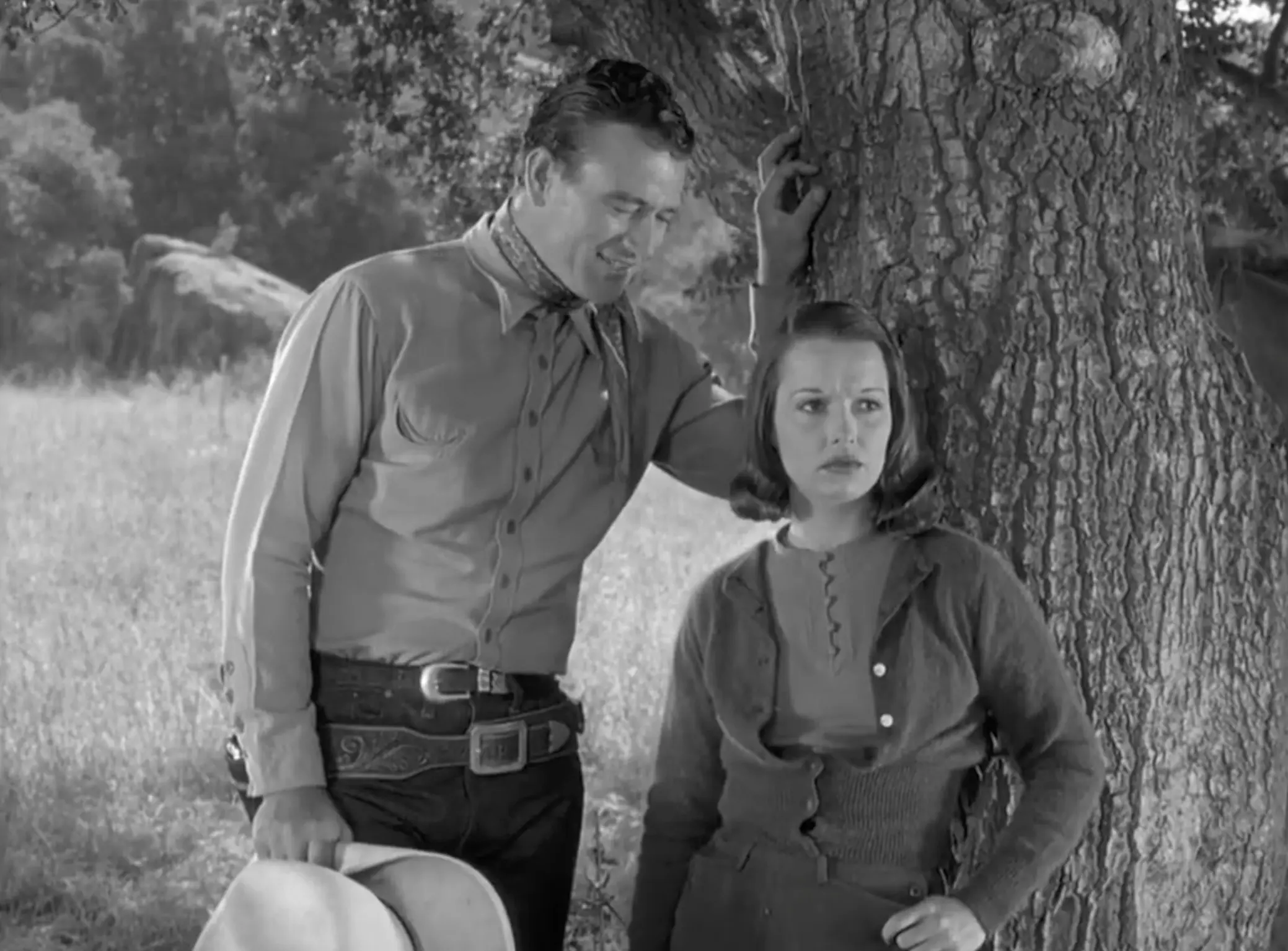
Overland Stage Raiders (George Sherman, 1938)
Notes
‘Three Thousands Hours of Cinema’, trans. by Jane Pease, in Jean-Luc Godard: a critical anthology, ed. by Toby Mussman (Dutton Books, 1968), 293–299 (p. 293). Originally published in Cahiers du cinéma, 184, November 1966, pp. 46–49.
Luis Buñuel: Un cinéaste de notre temps, dir. by Robert Valey (Office de Radiodiffusion–Télévision Française, 1964).
Joan Didion, ‘John Wayne: A Love Song’, Slouching Towards Bethlehem (Farrar, Straus and Giroux, 1968), 29–41 (p. 30). The quote is from Wayne’s dialogue in War of the Wildcats (1943).