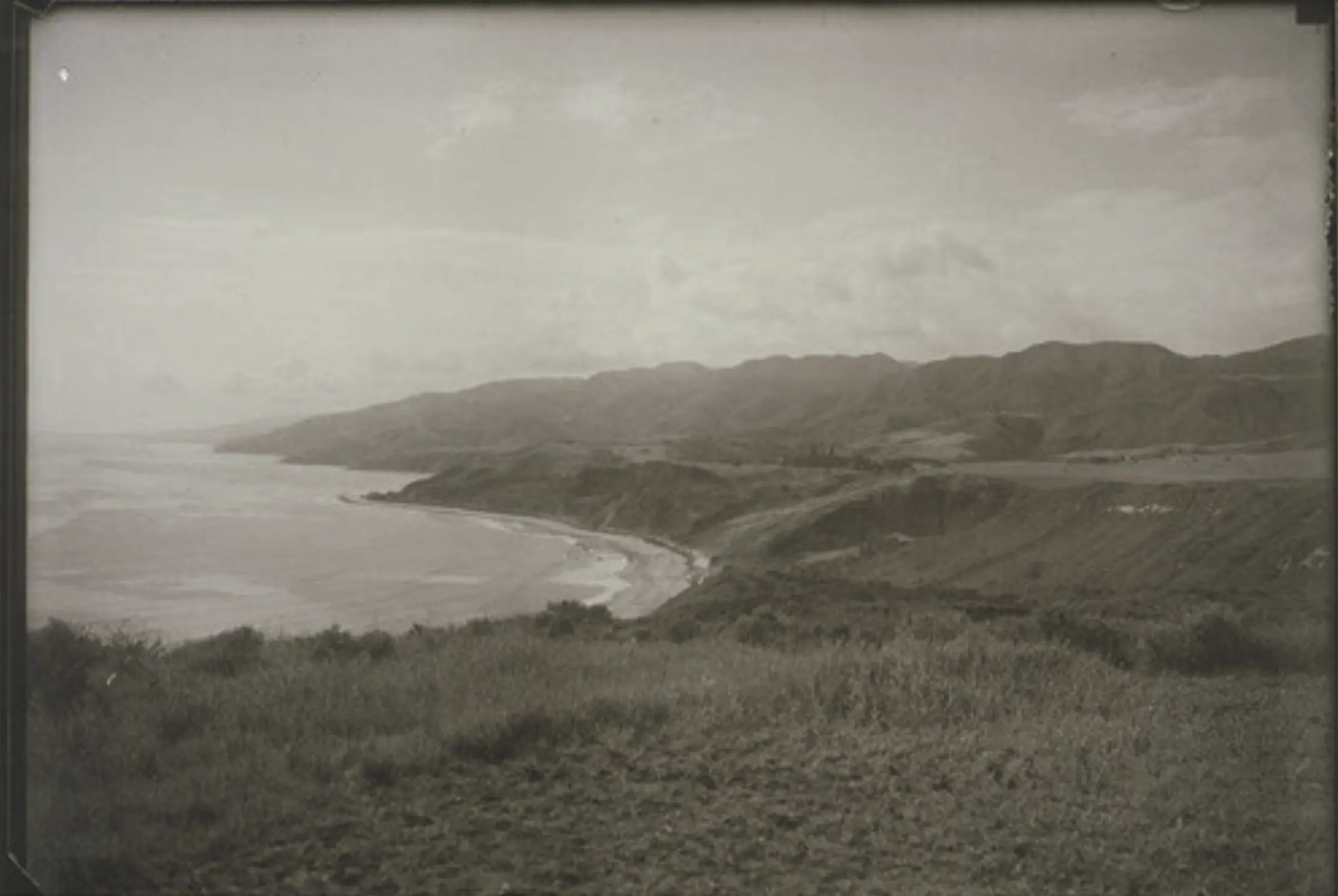
View from the Palisades looking toward Malibu — Inceville in the distance.
Take the Interstate 10 Highway as far west as you possibly can and you’ll pass through Santa Monica to reach the very edge of the Pacific Ocean. If you push further, the road snakes north and transforms into the starting point of the Pacific Coast Highway, a scenic 1,650-mile route that stretches along the entire U.S. West Coast from that point all the way to Washington. It’s at the start of that passage that you’ll find an exit for the western terminus of Sunset Boulevard. You’ll notice that this area, also known as Santa Ynez Canyon, holds the charred wreckage of homes, properties, and landscape destroyed by the Palisades Fire of 2025.
Fires are nothing new to Los Angeles. They’re as common as tectonic activity and the hot gusts of the Santa Ana winds; a fact of Angeleno life. Learning to live with this element goes back to the region’s Indigenous Tongva and Chumash communities who managed this natural occurrence through controlled burns before they were sent off to Spanish missions and dispossessed of their lands. Since then, blazes have become worse and increasingly uncontrollable. The disaster of the Palisades is only the latest in a series of catastrophes growing worse over two centuries.
It’s at this very lip of Southern California in the Santa Ynez Canyon that fire, land, and the stories of Indigenous people were part of one of the boldest experiments in motion picture history. What remains of that endeavor exists only in archival elements, surviving film prints, and the architecture of American studio filmmaking itself. Everything else is ash.
To sift through these vestiges, one finds a chase to capture echoes and shadows nearly faded to completion. It’s within these remnants that you’ll find something like a map, a set of conditions and possibilities that were yielded when history and a new technology collided. To stare into this abyss, you realize that this moment is both a history of cinema and its future.
* * *
In 1912, much of the film production in Los Angeles took place in Edendale, an area now known as something of a shoulder between Echo Park, Silverlake, and Los Feliz. A few production outfits were beginning to set up shop in the newly incorporated city of nearby Hollywood, but the majority of west coast filmmaking took place in a hub along Alessandro Street (now Glendale Boulevard). It was in this industrial hotbed that Thomas H. Ince, an up-and-coming actor turned producer, began cutting his teeth.
Thomas Harper Ince’s lineage was rooted in the transient world of stage performance, a background that eventually propelled him from theater and vaudeville into the nascent motion picture trade by 1905 with the Edison Manufacturing Company. He refined his sensibilities as a performer and coordinator at the Biograph Company, navigating the burgeoning industry under the formidable shadow of D.W. Griffith. It wasn’t until 1910, while at Carl Leammle’s Independent Motion Pictures Co. (IMP), that he transitioned to directing and was dispatched to Cuba to shoot films. Away from the restrictive gaze of the Motion Picture Patents Company, he directed one-reelers featuring luminaries like Mary Pickford, molding his craft in the isolation of the Caribbean.
In the closing months of 1911, Ince joined The New York Motion Picture Company, a film production and distribution outfit that sent him to Los Angeles. Throughout 1912, he found himself amidst the industrial churn of Edendale, carving out a name as a producer of rare foresight. Yet, the production limitations of that urban hub soon stifled his grander ambitions. Later that year, Ince ventured westward to secure Bison Ranch, a sprawling 460-acre expanse nestled within the Santa Ynez Canyon. This rugged landscape served as the bedrock for ‘Inceville’, a site where he pioneered a methodology that would fundamentally restructure the very architecture of American studio filmmaking.
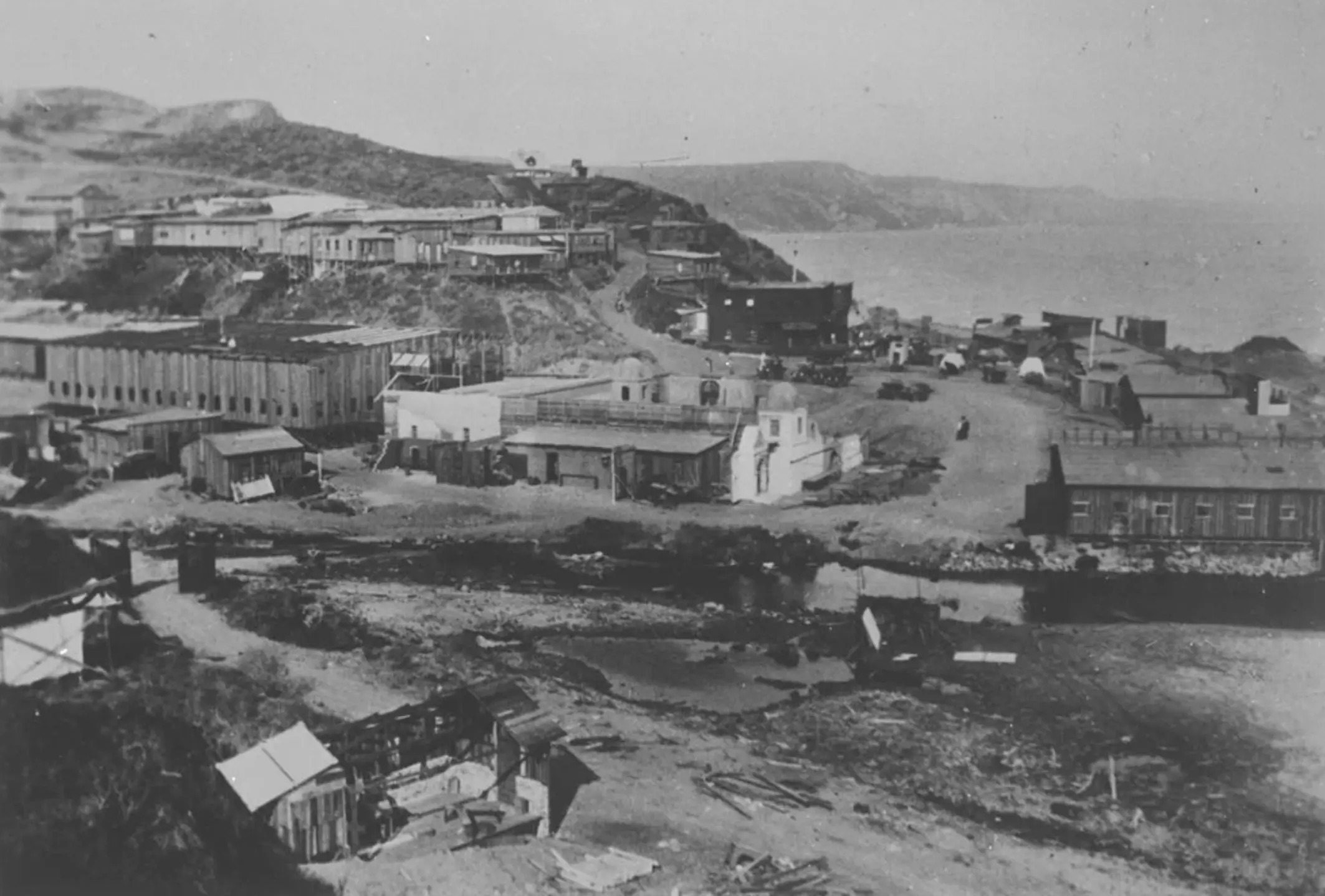
Inceville Studio Headquarters, Ernie Marquez Collection
Inceville emerged as a sprawling, multifaceted production complex, eventually encompassing thousands of acres of leased coastal terrain. Far from being a mere collection of exterior locations, the facility functioned as a self-contained industrial hub, embodying Ince's devotion to a vision of a disciplined, factory-inspired studio methodology. The canyon site boasted a comprehensive infrastructure, featuring silent stages, administrative offices, laboratories for film processing, and a commissary capable of sustaining hundreds of laborers. These grounds also housed an immense cache of props, ranging from vintage weaponry to battered stagecoaches. This centralized environment empowered Ince to exert rigorous control over every facet of the creative cycle, from the nascent screenplay to the definitive final cut, fundamentally reshaping the logistical architecture of American filmmaking.
A major component of the labor force of Inceville was secured through a calculated alliance between Ince and the Miller Brothers, whose legendary 101 Ranch Wild West Show was navigating a period of waning popularity for live exhibitions in favor of moving images. Sensing a symbiotic opportunity, Ince integrated the entire troupe — comprising 300 cowboys and cowgirls, vast herds of livestock that included cattle and bison, and roughly 200 Lakota performers — directly into the studio's hierarchy. This arrangement anchored the performers within the canyon, where the Lakota resided in a dedicated tipi encampment. This structure provided a vital reservoir of labor and a veneer of authenticity for Ince's Westerns, permitting these individuals — many of whom had endured the Indian Wars or displacement to reservations — to transition from the fading touring circuit into the blossoming motion picture trade.
Through the relentless industrial output and methodical genre focus of Inceville, Ince eventually secured his legacy as the ‘Father of the western’, cementing the frontier narrative as a structural pillar of the American cinematic tradition. He redefined the western as an essential cultural commodity by engineering an immense volume of work; during the single year of 1913, he orchestrated the creation of more than 150 two-reelers. This centralized control that Inceville afforded its creator led to the completion of hundreds of titles by 1914, successfully instituting the assembly-line methodology that would soon become the definitive template for the Hollywood studio system.
The synergy between Ince and the Indigenous performers under his employ frequently moved beyond simple labor, a dynamic exemplified by the Lakota artist William Eagle Shirt. Entering the studio hierarchy in 1912, Eagle Shirt appeared in seminal works such as War on the Plains and Custer’s Last Fight, yet his influence permeated the inner sanctums of narrative development. Acknowledged as a contributor to the scenarios for War on the Plains and The Battle of the Red Men, he integrated intimate knowledge of Lakota warfare and social customs into the productions. This partnership infused the films with a rare texture of authenticity, one which Ince intentionally sought after, representing a pioneering moment where an Indigenous performer actively shaped the storytelling architecture of the early motion picture industry and became cinema’s first credited Native American screenwriter.
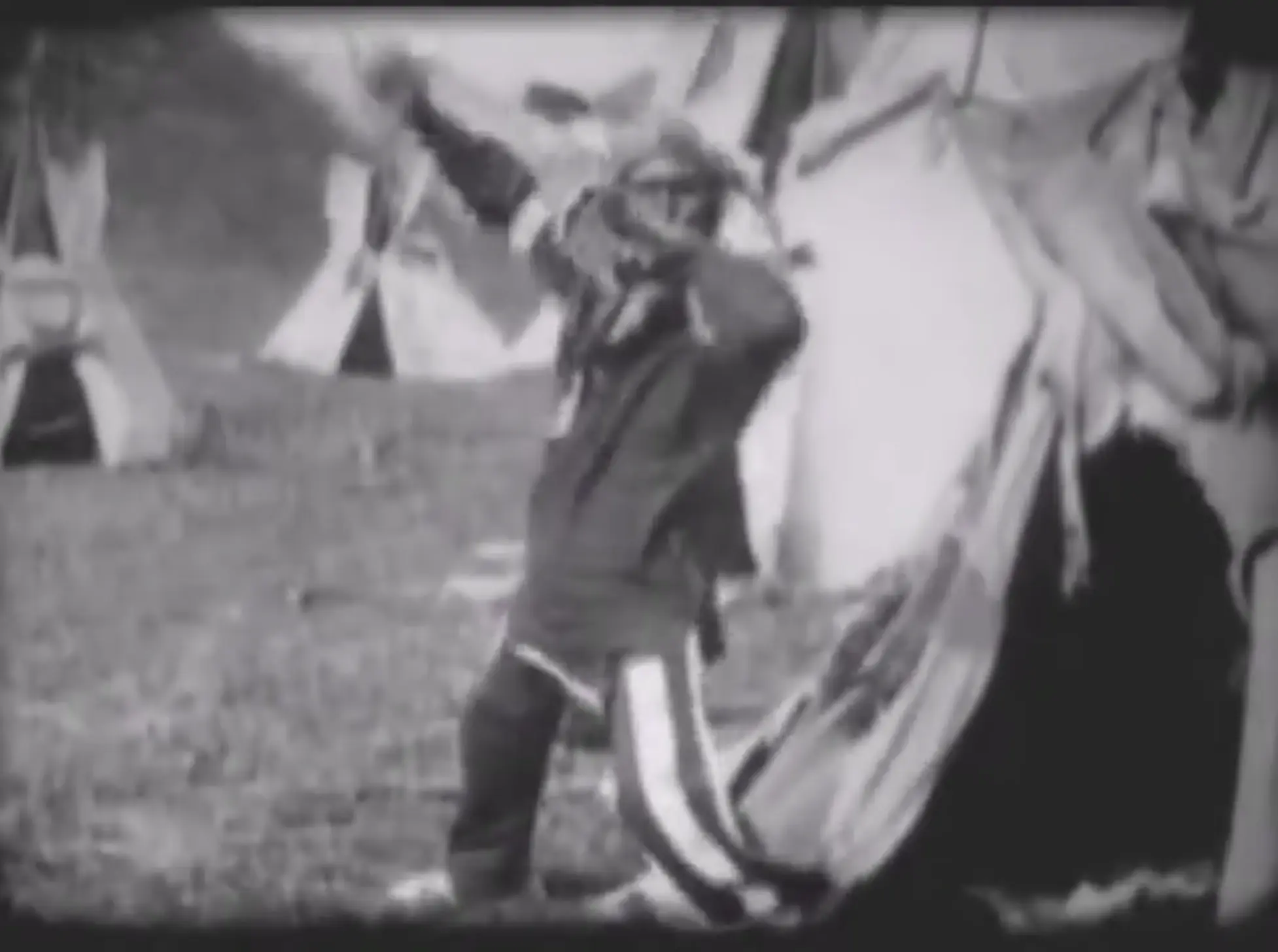
Custer's Last Fight (Francis Ford, 1912)
Luther Standing Bear, who arrived in Southern California in 1911, emerged as a central figure within the Lakota encampment at Inceville. During his time at the studio, his contributions were integral to the production’s operational needs, where he primarily utilized his exceptional equestrian prowess to bring a heightened sense of realism to Ince’s frontier narratives. As a key presence among the community of performers residing in the canyon, his work provided the necessary visual authenticity that the studio required to anchor its cinematic myths, serving as a vital component of the labor and skill that sustained the studio’s output during its formative years.
By 1915, the relentless expansion of Ince’s cinematic output had effectively outpaced the logistical capacity of Inceville. While the canyon provided an ideal backdrop for frontier narratives, its reliance on outdoor locations and rugged terrain could no longer sustain the modern stages and industrialized production design necessitated by his diversifying portfolio of war epics, domestic dramas, and comedies. During this pivotal transition, Ince forged a strategic alliance with real estate magnate Harry Culver, who envisioned a robust industrial foundation for his newly-founded municipality. Enticed by the promise of expansive, state-of-the-art facilities within the developing Culver City, Ince migrated his entire operation to a new studio lot situated on Washington Boulevard. The original canyon site was subsequently acquired by the legendary performer William S. Hart, who rebranded the grounds as ‘Hartville’, though the facility’s tenure as a primary engine of the motion picture trade had effectively reached its conclusion.
Following its stewardship under Hart and a later transfer to the Robertson-Cole company, the complex witnessed only intermittent activity, gradually succumbing to the industrial shift toward more modernized production hubs. By the summer of 1922, the once-vibrant studio had withered into a silent ghost town, its final physical vestiges eradicated on the Fourth of July when a massive fire swept through the canyon. This blaze reduced the complex to charred wreckage, leaving only a solitary, weatherworn church to oversee the ruins. Eventually, even this sentinel was reclaimed by the natural landscape of Santa Ynez, leaving behind nothing but the ash of a bold experiment and the enduring echoes of archival memory.
* * *
The definitive tragedy of Inceville lies not merely in its literal incineration, but in how its demise remains overshadowed by the dark, enigmatic fate of its creator. While Thomas H. Ince stands as a foundational architect of the Hollywood studio system — having engineered the ‘shooting script’ and the centralized, factory-inspired methodologies that served as the industry’s definitive template — these monumental innovations have been paradoxically submerged by the lore surrounding his death. His passing in November 1924, occurring amidst the high-society confines of William Randolph Hearst’s yacht, the USS Oneida, has fueled a persistent reservoir of sensationalized myths. Despite official records citing heart failure, the event’s circumstances birthed a series of unsubstantiated rumors involving other luminaries aboard Hearst’s vessel like Charlie Chaplin and Marion Davies, ranging from an accidental shooting to an orchestrated murder. This salacious narrative, frequently amplified by the era’s increasing number of Hollywood scandals, has fundamentally obscured Ince’s legacy, reducing a visionary pioneer of the trade to a mere footnote in the annals of urban legend.
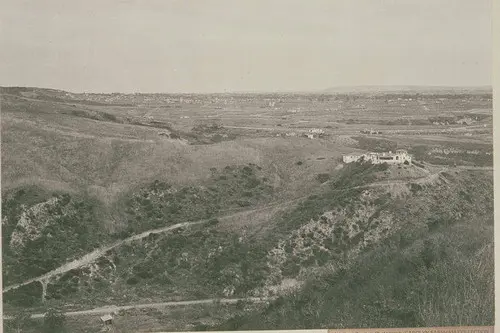
The Ince home, high above Inceville
Following the twilight of Inceville, the Lakota troupe largely returned to the Pine Ridge Reservation in South Dakota, yet a persistent few remained in Los Angeles to continue their labor within the Hollywood hierarchy. These figures exerted a lasting influence on the narrative trajectory of the industry and the evolving presence of Indigenous performers. Central voices, such as Luther Standing Bear, leveraged their immersion within Ince’s factory-inspired system as a crucible for a subsequent ideological shift.
As an early participant in the Screen Actors Guild, Standing Bear utilized his experience to challenge the industry’s reliance on reductive caricatures. He, alongside William Eagle Shirt, championed a paradigm of representational reform, asserting that Native American identities must be inhabited exclusively by Indigenous performers in substantive, leading capacities. To anchor this mission, he collaborated with fellow performers in 1926 to organize the War Paint Club. A decade thereafter, Standing Bear forged a strategic alliance with Jim Thorpe to institute the Indian Actors Association, an entity committed to shielding the rights of Native American laborers and insulating their cinematic identities from the systemic ridicule and defamation that characterized the still-forming industry. By harnessing the knowledge forged within the topography of the canyon, they sought to confront the systemic exclusion and disparagement that defined the early history of Indigenous people in American film.
* * *
Despite its immense production volume, Inceville functioned as an arena defined by potential — a bold exploration into the artistic and commercial limits of the medium. While the ultimate triumph of this undertaking is found in the industry standards it established, a specific enclave within the studio’s territory offered a different vision. Located in the Lakota encampment, this was the site of a unique proposition, one that may never have reached its complete fruition but lingers in what might have been.
The Indigenous performers of this epoch, primarily Lakota from the Pine Ridge Agency, navigated the suffocating assimilationist mandates of the federal government’s Office of Indian Affairs by securing seasonal labor with touring exhibitions like the Miller Brothers 101 Ranch Wild West Show. These theatrical engagements served as a vital legal conduit, permitting a temporary exodus from the systemic deprivation and mortality that defined life within the reservation system. Thomas Ince’s calculated integration of this troupe into the industrial output of Inceville effectively transmuted an ephemeral circuit into a localized, sustained occupancy, extending the autonomy afforded by their initial contracts. By anchoring themselves within the canyon’s tipi camp, the Lakota utilized this stabilization to systematically bypass bureaucratic prohibitions against their traditional attire, ceremonial dances, and cultural lifeways — activities otherwise suppressed by federal authorities on or off the reservation. Under the veneer of paid cinematic labor, they carved out a sanctuary to preserve the rhythms of a pre-reservation existence. This proximity to the heart of production further enabled a critical negotiation of creative agency; through the efforts of luminaries such as William Eagle Shirt, the performers infiltrated the studio’s narrative architecture, displacing reductive frontier tropes with an authentic infusion of Lakota social customs and tactical expertise.
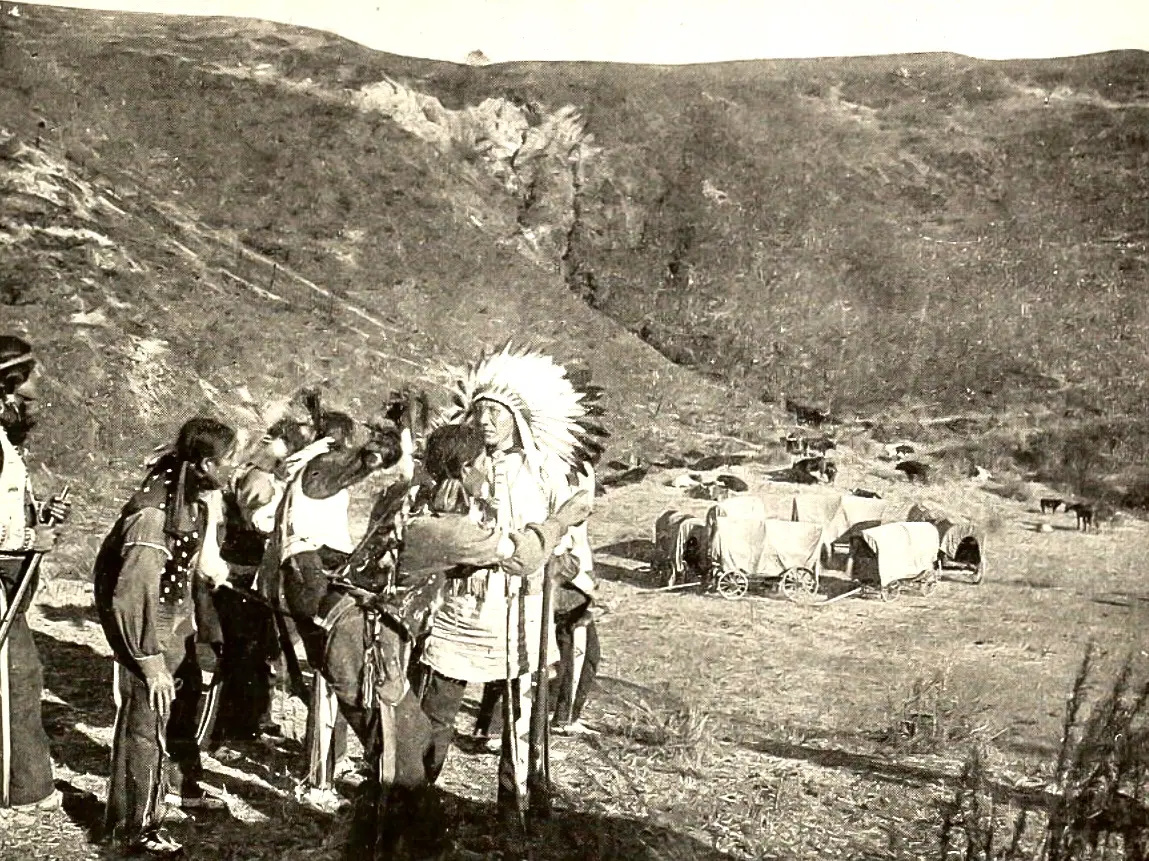
War on the Plains (Thomas H. Ince, 1912)
Though explicit archival documentation capturing the personal ruminations of the Lakota during their tenure at Inceville remains largely elusive, the peripheral vestiges of their presence offer a window into their lived reality. The representational advocacy that Luther Standing Bear championed throughout his subsequent career was undeniably forged within the industrial output of Ince’s operation, sparking an ongoing discourse regarding whether this era functioned as a mechanism of exploitation or a source of burgeoning autonomy. Ultimately, these interactions suggest a sophisticated tier of strategic negotiation; Standing Bear and his community leveraged their integration into the studio’s factory-inspired production to anchor a degree of legal and creative sovereignty. This impulse toward subversion is further illuminated by the trajectory of William Eagle Shirt, whose emergence as a credited scenario writer underscores how the Lakota actively permeated and reshaped the medium’s narrative architecture. Within these shadows of Inceville’s history, Indigenous performers are revealed not as stationary subjects, but as foundational cinematic pioneers who navigated the logistics of early American Cinema to advance their own shared objectives.
The enduring legacy of the Lakota presence within the topography of Inceville remains a site of profound historical inquiry, its ultimate trajectory tethered to the sustained industrial demand for the frontier narrative. One might contemplate if this stabilized occupancy would have catalyzed a more robust integration of Indigenous professionals into the evolving Hollywood hierarchy, or if other Indigenous nations would have mirrored this strategic navigation to confront their own systemic social and economic deprivation. There also exists the evocative potential that the Lakota might have pioneered a sovereign cinematic tradition — an architecture of storytelling culturally self-determined in a manner parallel to the emergence of African American film at the time. Standing amidst the contemporary ruins of Santa Ynez Canyon and looking toward the Pacific horizon, one can almost perceive the transition those performers navigated upon exiting the wild west show circuit. Having witnessed the decimation of their traditional world, they were forced to endure by performing its remnants for the very beneficiaries of its destruction. Yet, at this definitive edge of the land, they came into a new world that was manifesting itself on a new medium and they used it to build something by and for themselves.