I think most of us who made our living working in the western picture field enjoyed it. I did, if I ever had time to think about it. But make no mistake, we worked like sin, for it was a hard, driving life. We made pictures on impossibly small budgets, on impossibly short shooting schedules. We worked in blistering Arizona desert heat, often over 115 degrees in the shade. We worked in bone-freezing cold in Utah, Nevada, and Colorado. We worked at night, on location, hoping and praying that a windstorm wouldn’t sweep down our lights, or a rainstorm flood [sic] us out. We worked from sunrise to sunset. […] The important thing was to get the picture in the can, come hell or high water. [1]
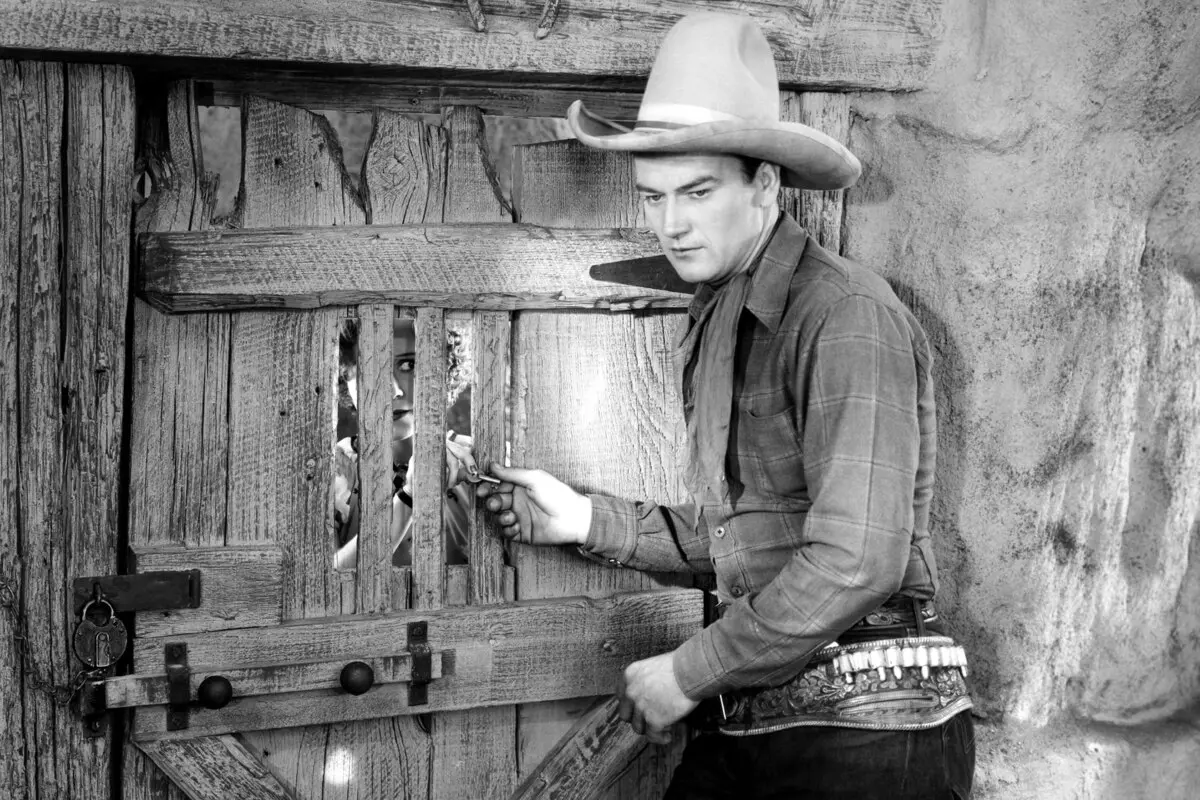
Randy Rides Alone (Harry L. Fraser, 1934)
Harry L. Fraser made B westerns. Working in the 1930s during the western’s supposed critical and commercial nadir, the bulk of Fraser’s career took place during a period likely unfamiliar to even the most intrepid cinephile. Bookended, as is told, by the ruin and rebirth of the A western and the genre’s subsequent inundation of the industry in the forties and fifties, the decade of the Depression is the province of an altogether foreign object. To have produced a ‘western’ in this period meant filming a picture in a few days with a budget that could be as low as $6,000, made for a forgotten or near-forgotten company, featuring one of countless cowboy stars, and working with a script and title that seemed practically arbitrary. If the so-called ‘genius’ of the Hollywood studio system could crank out glossy products at a rate that, from our perspective, is unfathomable, western production in the thirties was practically lightspeed. These were the true B westerns, and Fraser could make ‘em.
The B picture, in its most generic sense, is a form defined by alterity. Flourishing in the 1930s and 1940s, the B film was defined by its presumptive position on the lower half of a double bill, its relatively attenuated budget and shooting schedule, and low running times with less-than-notable stars (if you could even call them that). The B film was facilitated by the growth of the double feature as well as the standardization of studio production and exhibition. Product was continually needed and exhibition could be ensured. Unlike the A picture that operated on a percentage model and relied on intangibles, the B film had a differing relationship to risk that pushed it onto the exhibitor. Promoted through block-booking and states-rights models, the films were sold at a flat-fee and, in the case of the large Poverty Row studios and the majors with B units, typically implied guaranteed sales. As Brian Taves has written, ‘By facilitating the industrial basis of filmmaking, B’s permitted each studio and its myriad personnel to remain active year-round. Turning out some fifty pictures annually allowed the studios to balance a large overhead by using sets, stages, ranches, and contract talent on a nearly continual basis.’ [2] The B picture provided the financial bedrock for the studio system through this attempt at consistent returns and utilization of capital investment. This was a moment where the motion picture perhaps came closest to being a commodity in the strict sense, fungible and undifferentiated. And it was to this position that the western film was relegated by the early 1930s.
The corpus of thirties’ B westerns presents few canonized highs. It is instead a morass of slight, repetitive, unrecognizable films made by unrecognizable names. Who among us have familiar feelings (let alone any familiarity) with cowboy stars like Bob Steele, or Buck Jones, or Kermit Maynard, or Bill Cody? What auteurist has reclaimed S. Roy Luby, Robert N. Bradbury, John P. McCarthy, or Alan James? [3] How about Harry L. Fraser?
Fraser was born in 1889 in San Francisco. Like many who made their way to Hollywood in the early 20th century, he spent much of his early life on stage. An actor first and foremost, he made a living joining stock and touring companies, living, as he described it, ‘out of my wardrobe trunk, hopping from one city to another, often in one-night stands’. [4] After acting in Pathé’s 1916 serial The Laughing Mask, Fraser fully made the transition to motion pictures; joining Universal in New York in 1918, he began writing and directing. By 1924 he was in Los Angeles. Eventually linking back up with Universal and RKO–Pathé in the later twenties, Fraser landed writing and directing work for serials and two-reel comedies.
Those would be Fraser’s closest attachments to major studios. By the 1930s, he was firmly wedded to the western film, of which he would make nearly forty in the decade. All would be made and distributed as B pictures by so-called ‘Poverty Row’ companies. Low-budget filmmaking in the 1930s, however, was somewhat more fractious and diffuse than one might imagine. In 1935 Republic Studios was founded by Herbert J. Yates as a merger among his Consolidated Film Laboratories, Nat Levine’s Mascot Pictures (of which Yates had been a financier), Trem Carr and W. Ray Johnston of Monogram Pictures, and several other smaller companies. By the end of the 1930s, with Monogram splitting off once again, ‘Poverty Row’ had come to mean Republic, Monogram, and, later, Producers Releasing Corporation. But before this, and sometime after this initial merger, the boom in double features fostered an expansion of independent production in Hollywood. Fly-by-night companies capitalized on this demand, often raising money for only a handful of pictures before disappearing. [5] To tell a story of Harry L. Fraser is, in part, to tell a story of this moment. Fraser operated at a level subterranean to what most of us may call to mind when we think of a cheap western, his career only occasionally breaching the surface of that more esteemed trifecta established later.
From Broadway to Cheyenne (Harry L. Fraser, 1932)
A certain narrative of classical Hollywood periodizes it as ossifying around vertical integration until the late forties and the Paramount Decree; with the fifties comes independent production concomitant with the studios’ withering away and competition from television. But one look at a career like Harry L. Fraser’s complicates this impression, revealing production practices that were much more variegated. Much of his work resembled more closely a package-unit, where an independent producer was able to finance a film to then leverage existing distribution networks — such was the case, for instance, in the two films Fraser made in 1934 with John Wayne, produced by Paul Malvern’s Lone Star Productions but released through Monogram. From 1931 to 1934, Fraser directed around 17 westerns for Monogram. From 1932 to 1939, Fraser directed around 28 non-Monogram westerns with a long list of cowboy stars — Rex Bell, Hoot Gibson, Reb Russell, John Wayne, Harry Carey, Bill Cody, Jack Perrin, Fred Kohler, Jr., Gene Austin, Grant Withers, Ken and Kermit Maynard. And with an equally long list of producers and distributors: M.H. Hoffman and Allied Pictures, Willis Kent and Majestic, Alfred T. Mannon and Resolute, William Berke and Ajax, Ray Kirkwood and Crescent, Walter Futter and Diversion, Max and Arthur Alexander and Colony, Maurice Conn and Ambassador, Grand National, Sunset, Al Lane, Berke–Perrin.
This is not an example of an auteur searching for vanity-project funding; this is a workman toiling at the margins of an already marginal filmmaking practice. There was something even below the lowest rung of the ‘studio’ system and ‘big’ companies like Republic or Universal, without — and I say this with tongue in cheek — star directors like Joseph H. Lewis, George Sherman, or Joseph Kane. Below this were upstart producers like Maurice Conn, cutting picture deals on a states’-rights basis, made by guys like Harry L. Fraser.
Though baldly an ‘auteur’ — he frequently wrote and directed his own scripts — Fraser is hard to pin down stylistically. It’s difficult to find any peculiar structural antinomies, thematic preoccupations, or formal flourishes. What Fraser is, though, is paradigmatic of not only an alternative filmmaking economy (i.e., the independent B western), but an alternative filmmaking style, one not wholly his own. Caught up in the rigid constraints of genre convention and production methods that leave one with little room to breathe, the films approach a pure formalism suffused with contingency.
* * *
And there were always emergencies and unforeseen problems. A member of the cast who turned up with a black eye after a brawl over a card game. A horse that suddenly went lame. A herd of cattle that was unexpectedly quarantined. A location that, for any number of reasons, didn’t work. But one thing about our crews — they learned to be inventive. They had to be. We substituted, faked, changed business, rewrote dialogue, and went on with the show. The important thing was to get the picture in the can, come hell or high water. [6]
Back in those early days we would figure on having about two days of interiors and four days of exteriors. We’d shoot the entire picture in six days... sometimes even in five days... we’d have the two days of interiors as protection against the weather because sometimes there'd be a heavy fog that would come in and stay til about 1 or 2 o’clock in the afternoon which made it impossible to shoot. So the interiors were really protection against the weather. We’d make a flat deal with the studio. All of them had interior sets for westerns and they were all principally the same. [7]
Get it into the can today — it may rain tomorrow. [8]
A western meant cowboys, horses, the West, action. Unlike some of the more tedious B films, where men walk in and out of rooms on a soundstage, the B western was necessarily shot on location. Look at the opening of 1934’s Gunfire. The first shot is of a group of ranch hands resting beneath a tree, along with a wagon; these objects construct a plane in front of a herd of cattle. As they sing we cut to images of Rex Bell in front of the herd, and one remarkable shot of the herd milling about in front of an extreme long shot of the mountains in the far distance, essentially dividing the image into fourths. In the sequence, the cattle are spooked and stampede; we then see a montage of the cowboys and Rex Bell attempting to corral them. In every shot of Rex or the cattle, the camera pans and tilts, often incrementally, jerkily. Sometimes Rex will move so quickly out of frame, seemingly unexpectedly, that the camera cannot follow; in one shot, the camera pans to follow but briefly turns back. Another: Rex rides to the right, the camera panning to follow; it stutters, before continuing left though more slowly as Rex leaves the frame; the camera slows down then to follow the cattle herd, tilts up, pans left, tilts up again, and pans left again. Each of these movements is discrete — tilt, then pan, then tilt, a sort of on-the-fly adjustment of a likely singular cameraman adjusting the two dimensions. Every shot here is filled with accident, with contingency, in the camera work and the composition. Indeed, throughout Fraser’s oeuvre, in nearly every shot on location that has some semblance of camera movement, one finds these minor corrections and adjustments. Four days on the range doesn’t leave much time for dailies, let alone reshoots.
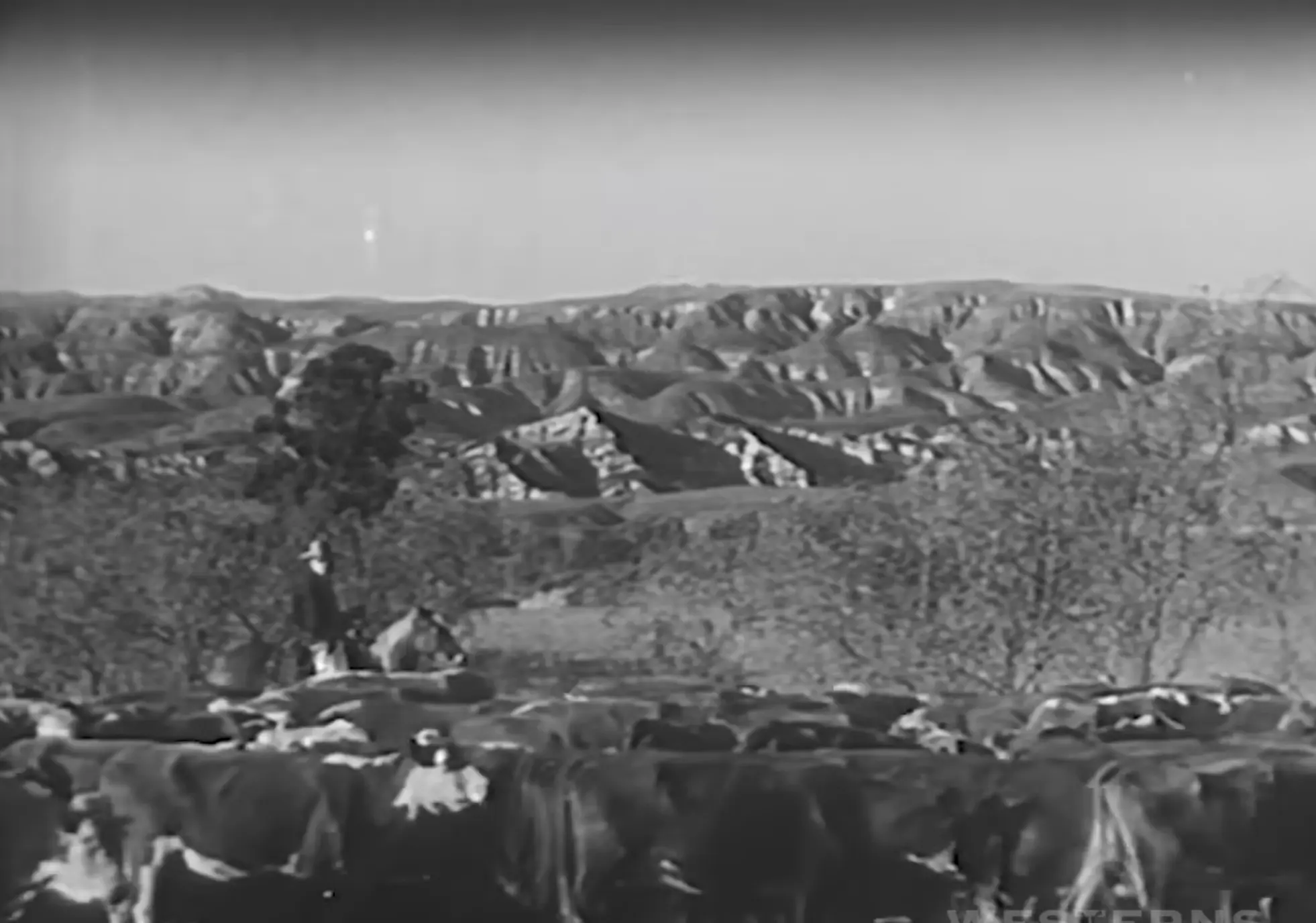
Gunfire (Harry L. Fraser, 1934)
Relatedly, there is a dearth of what David Bordwell would call ‘analytical editing’, clear establishing shots of relations of characters in space, into which one cuts. Shot–reverse shots do exist, but mostly on interior sets. Even then, when characters are speaking, we often get long shots that cut to another long shot. Or, throughout Fraser’s films, quick reframings through pans and tilts, moving toward another person or object when speaking or referred to.
In the remarkable Saddle Aces from 1936, one of Fraser’s best films, a scene takes place inside a house, though seemingly not a set. The lighting is hard and direct, lowkey lighting with sharp, distinct shadows — one can imagine lighting equipment was at a minimum. Characters are framed right against the wall, and it is clear the depth of field is quite shallow, a necessary constraint of location filming in such a space. But again, we do not have conventional shot–reverse shot, no cutting along an axis, no establishing shot of the space. We cut, instead, between two people talking and reaction shots, shots usually of one not engaged in the conversation. We are getting something more approaching montage than découpage; the space is not broken down in advance, but seemingly constructed in editing. Shoot as much as you can, worry about form later.
The 1930s’ B western is a problematic object for those more comfortable with a style of mythological and sociological interpretation, shedding as they do the loaded topical and thematic signifiers of a typical western. It is not foreign to the B western to deal with historical themes — see Fraser’s 1932 film Texas Pioneers, or 1935’s The Pecos Kid, or 1936’s Cavalcade of the West. Settlement is contained in all these: of Texas, of Spanish colonization, of the California gold rush. But it is just as, if not more, common to see a less loaded treatment. Witness Rex Bell’s and Fraser’s early collaborations. Broadway to Cheyenne (1932) sees Bell as a detective following the mob out West; in Diamond Trail (1933) he does the same, only as a reporter; in The Fugitive (1933) he is a government agent following an escaped federal prisoner; in Rainbow Ranch (1933) he is called back home from the Navy. 1936’s Romance Rides the Range sees an opera singer return to his vacation ranch only to be embroiled in gang feuding; in that same year, Wildcat Saunders follows a down-and-out boxer who heads west for rejuvenation, also finding himself amidst trouble. [9]
Most interesting, though, are the westerns with little indication of time period. While it is not unusual to see a car or an airplane in a B western, one often gets no orientation. The B western is by its nature a genre of repetition. A cowboy star appears again and again, wearing usually the same clothing and riding the same horse, in films with titles that convey next to nothing: Wagon Trail, Aces Wild, Fighting Through. That a star could be alternately in a prison-heist-cum-western in one year, and in an historical picture in the next, wearing near-identical costumes on near-identical sets, begins to give a placeless quality to those that do not explicitly articulate it (and, even then, this placing is often cursory at best).
This placelessness and repetitive quality call little attention to the script. What is so striking in Fraser’s 1930s’ westerns is an evacuation of excess morality or thematics — these are not films that sit with a surface ‘idea’. The films pare the genre into sharp dualities: good/bad, self/other, man/woman, Law/Nature, rendered starkly and simply without nuance. This is a sparse, skeletal plotting onto which a film can be placed. Because of this, the films are exercises in kinetic and spatial modulation, on a shot-by-shot level and on the whole. Fraser’s westerns come close to a sheer formalism.
Another Fraser high, 1934’s ‘Neath the Arizona Skies, is structured like a classic melodrama — a chase, a romance, and a final showdown wherein our heroes are surrounded, fending off the bad guys as the reinforcements arrive in the knick of time, complete with parallel editing. The first chase is itself remarkable. Fleeing with the child in his protection, John Wayne (and his pursuers) ride across fifteen separate shots over the course of two minutes and fifteen seconds. No music accompanies this, only the sounds of the horses. Only two tracking shots here; the rest pans from right to left or left to right, in typical chase style. One landscape is repeated twice, but reframed, getting to separate ‘hills’ from the same location — ‘a tree is a tree’, after all.
Fraser was, at heart, a silent-film man, emerging from the stage, from the melodrama, from the silent serial. As he himself wrote, the 1930s’ B western ‘emerged from the silent era […] stilted and hackneyed’. [10] Fraser’s films, but also films like them, speak to this. The emphasis was on action and on quick pace, made on location with a small crew. If the B western is daunting and unfamiliar, it is perhaps in part because of it being out of step with what one thinks when one hears ‘Hollywood western’. But in inheriting a strange and quasi-silent sensibility, the 1930s’ B western is its own forgotten, alternative mode lodged within Hollywood, a practice that at its best can be strikingly beautiful. Pause one of these films on any exterior shot of a trail or a forest, and you’d be forgiven for mistaking it for Griffith. Harry L. Fraser sure could make a picture.
Notes
Harry L. Fraser, ‘Early Stars in the Western Sky’, in I Went That-a-Way: The Memoirs of a Western Film Director (The Scarecrow Press, Inc., 1990), eds. by Wheeler W. Dixon and Audrey Brown Fraser, 37–57 (p. 55).
Brian Taves, ‘The B Film: Hollywood’s Other Half’, in Grand Design: Hollywood as a Modern Enterprise, 1930–1939 (Charles Scribner’s Sons, 1993), ed. by Tino Balio, 313–350 (p. 313).
It is taken as a joke in Les Sièges de l’Alcazar that someone would devote their time to Sam Newfield — has anyone answered this call?
Fraser, ‘Before the Camera with Pearl White’, (1990), 67–70 (p. 67).
Michael R. Pitts’s Poverty Row Studios, 1929–1940 (McFarland, Inc., 2005) notes 55 companies worthy of commentary.
Fraser, ‘Early Stars in the Western Sky’ (1990), p. 55.
John Brooker, ‘Maurice Conn chats about his filmmaking days’, The Old Corral, <https://www.b-westerns.com/conn.htm>.
Fraser, ‘Early Stars in the Western Sky’ (1990), p. 47.
Higher-budget, non-Fraser fare operates in this mode, too, as in Paramount’s Hopalong Cassidy series, or Republic’s The Three Mesquiteers.
Fraser, ‘Early Stars in the Western Sky’ (1990), p. 56.