A mystery resides at the edges of Tim Holt’s B westerns — the mystery of the wind in the trees. According to Tom Stempel, ‘in many of the films the wind is blowing in the trees in the foreground while there is no wind in the trees in the background’. [1] My sampling of these films is admittedly not nearly as extensive as his. Still, I struggle to identify the exact pattern he is referring to. Take the more tree-heavy sequences toward the end of Riders of the Range (1950). As Trump Dixon guides Kansas Jones to the Ringo Kid’s hideout, the wind is visibly blowing through both the foreground and background trees. In the immediately preceding scene, where the sheriff detains Chito Rafferty, there is virtually no wind at all in any of the trees. The whims of nature do not appear to abide by such strict formulas.
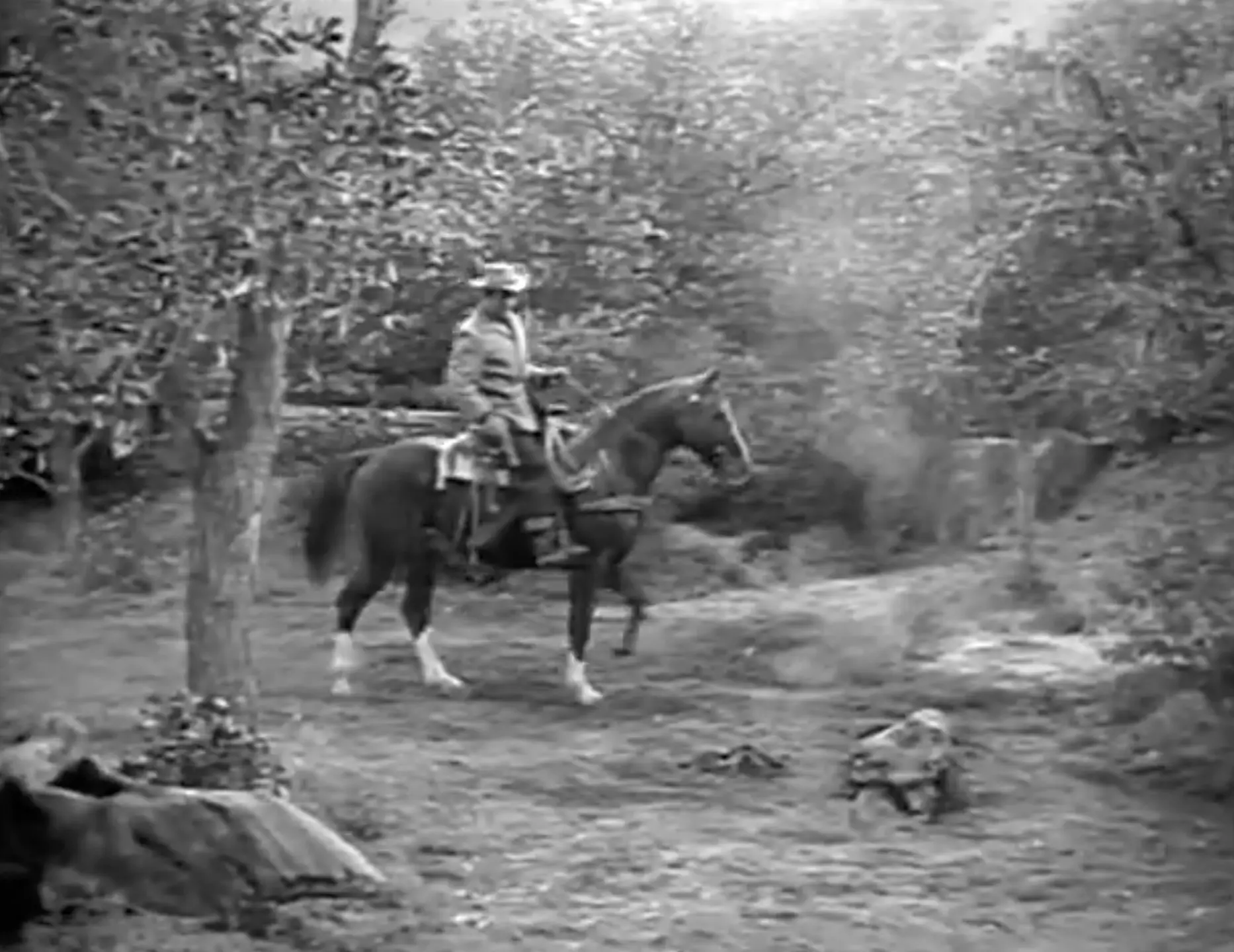
Riders of the Range (Lesley Selander, 1950)
Even if the specifics of Stempel’s observation aren’t entirely accurate, it’s an observation that nonetheless illustrates a pertinent point regarding the arbitrariness of nature. The very fact that, ‘unlike many B westerns, the Holts did not use many rear projection shots’ and instead leaned heavily on actual location shooting grants these films their sense of life, the presence of something seemingly contingent in what is otherwise formulaic and pre-planned. [2] Lesley Selander and J. Roy Hunt may defer to another one of their trusted high-angle shots during a climactic shootout or stick to an unobtrusive panning wide shot during a midpoint chase, yet there remains the possibility that a set of branches or a gush of dust drifting in just the right way could give the impression that we are witnessing a completely novel time and place.
Textually, this novelty more often than not results in a feeling of precariousness rather than a feeling of newfound potential. The archetypal Tim Holt hero is a man victimized by deception, initiating a process by which his personal and economic autonomy also comes into question. At the core of films like The Fargo Kid (1940), Bandit Ranger (1942) and Thunder Mountain (1947) is a conspiracy, not so vast given the runtime, in which the misidentification of Holt as a contract killer or a murderer is necessitated by saloon owners, roaming outlaws, and their governmental co-conspirators as they fight over land and cattle. Befitting the format of these films, Holt’s way out is not an implosion of the system as a whole but a simple reappropriation of the same tactics of deceit, now used against those who dealt them out first. In Riders of the Range, Kansas can only prove his innocence and avenge Dusty Willis by tricking the police into giving up their firearms and using Trump as a cover to enter the Ringo Kid’s hideout. What is tactically convenient is also a reaffirmation of the logic underlying the status quo. Such pervasive fraudulence, whereby every interaction is unreliable and every piece of information is distorted, acts as a form of social domination, one that undermines any chance of democratic deliberation and accountability.
The constraint of a single hour and its narrative shortcuts prevent the Holt films from achieving a ‘temporalization of the distinction between seeming and being’, Karl Marx’s basis for depersonalizing ‘the socialist accusation of fraud’. [3] The interpersonal acts of fraud depicted in these films, then, possess little explanatory value, as infuriating as they may be for the audience to experience. After all, ‘the B western in the forties seemed to exist out of time. Its heroes and plots looked back to those of the thirties’. [4] Such a timelessness, unsurprisingly, is not terribly conducive to Marxist historicizing. These are more works of myth than sociology, undergirded by the ‘morality of a world in which social good and evil, in their simplicity and necessity, exist like two primary and basic elements’. [5] Perhaps the wind in the trees carries a different connotation, one closer to Immanuel Kant’s belief that the beauty of nature can direct individuals to the morally good. The focus shifts away from the specifics of economic conflict toward an ethical romanticism. Holt westerns wrap up so abruptly because the moral order of the genre must make its forceful intervention and restore balance, even after all the bloodshed.
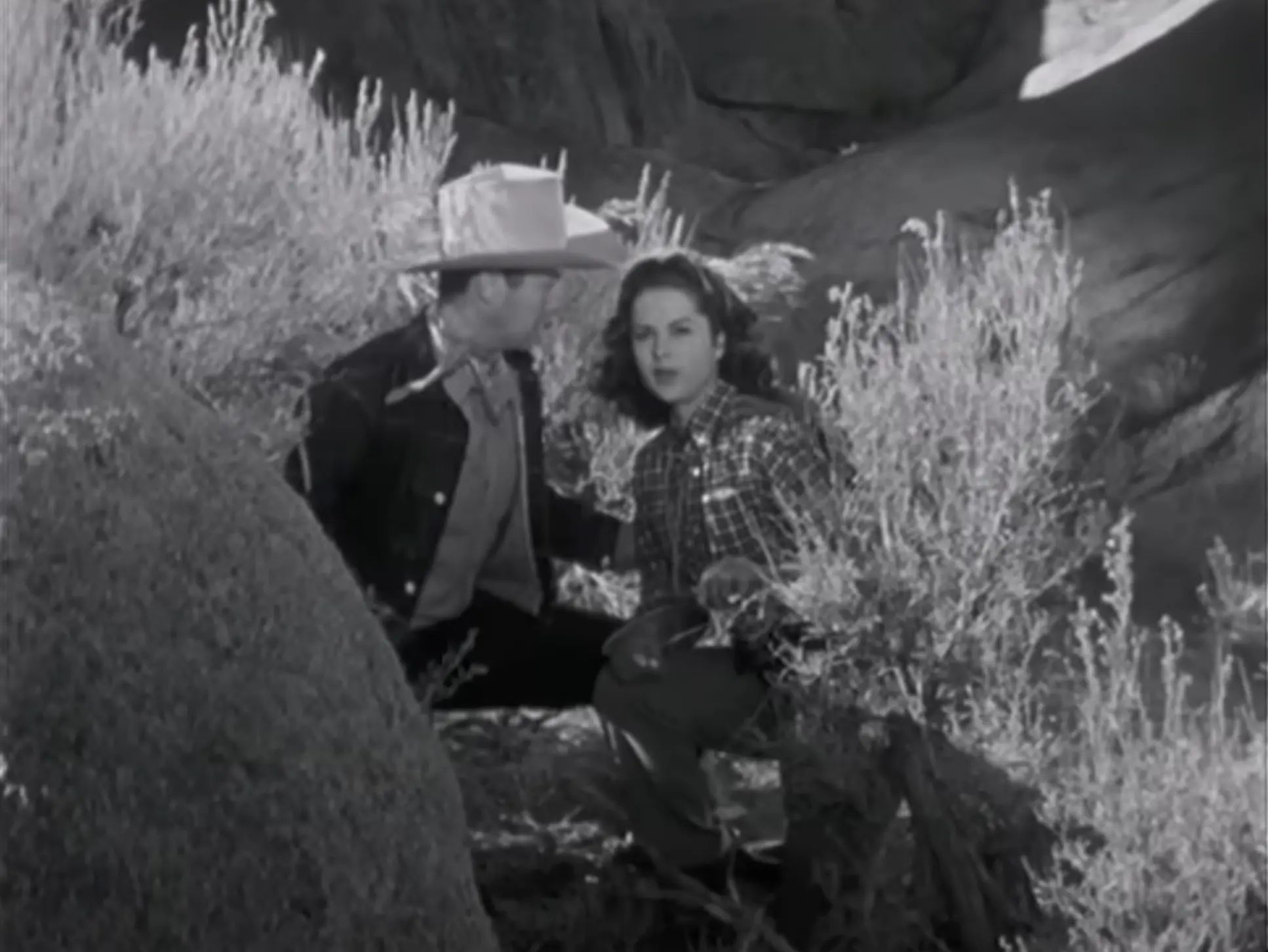
Thunder Mountain (Lew Landers, 1947)
André Bazin locates this moral order in the western woman, asserting that ‘within her is concealed the physical future, and, by way of the institution of the family to which she aspires as the root is drawn to the earth, its moral foundation’. [6] In one fell swoop, he connects the morally good and the natural world to the ostensibly ‘feminine’ desire for a child. Evidently, this is reactionary essentialism, but it does accurately reflect the function women serve in the Holt westerns. The leading woman is frequently the wife, daughter, or sister of Holt’s adversary, and it is through slowly earning her love and trust that Holt is able to overcome the dispute at hand. Everything must return to the family as a facilitator of both social and biological reproduction. Most egregiously, the Holt women who break the hardest with standard markers of femininity, such as Jessie Arnold in Stagecoach Kid (1949) and the aforementioned Dusty in Riders of the Range, are denied their capacity to handle their own troubles since they are, at heart, still just women who need to be protected. Holt’s heroes might even go so far as to spank their rear to enforce the point.
Of course, women are not just fixtures of a natural landscape, imbued with a moral end for men to contemplate and discover. Dusty shares the center of the frame with Kansas and Chito, claiming an equal share of the audience’s attention. These are ultimately commercial narrative films, dedicated to forming emotional identification through characters. The wind in the trees, wherever it might appear, is merely a garnish. In this sense, the Holt westerns resemble the early cinema of attractions, where ‘no film was ever made in which wind moving through leaves was the express attraction’. [7] The specific kind of cinematic beauty that D.W. Griffith mourned was mostly incidental, not entirely without importance but also subordinate to other subjects of fascination. There is no romantic origin for cinema to regress toward.
Realizing this should be a great source of freedom. The filmic index is purely mechanical, testifying to the sheer existence of an object without necessarily imbuing it with a particular meaning. As argued by Nico Baumbach, the potential in such a hollowed-out sign can still be revived ‘as long as we do not return to Griffith’s Victorian sensibility and link that potential to a nostalgic desire to restore natural beauty to art, but rather see it for the opposite effect — the linking of art to politics by freeing art from both moral and occult projections… We can revive its potential only by deflating its mystery’. [8] In other words, the ambiguity offered by the cinematic image should be treated as the starting point for critical thinking and not its cessation in submission to an ineffable ‘authentic interiority’ of the natural world. Actually confronting what the image tangibly shows entails an understanding of the material relations being depicted between people and their environment, as well as the formal means by which those relations are clarified.
One of those crucial means is découpage, a concrete aspect of the production process prior to its status as a muddled theoretical concept. Notably, the classical era’s task of parcelling out shots in accordance with a shooting script was more than likely performed by craftswomen, ‘because assembling was one of the few jobs in the classical film industry deemed menial and insignificant enough to be entrusted to a woman… we know relatively little about their work, and they enjoy near invisibility in film history’. [9] This neglected history is indicative of many issues, ranging from the sexism of the industry’s division of labor to the lack of production-related curiosity and research in film scholarship. Yet it also points to one of the radical possibilities offered by the practice of découpage, namely that it is ‘a diffuse, anonymous process: in French cinema (or any other cinema that I am familiar with), no screen credit for the découpage technique exists, in part because it is often highly collaborative and collective’. [10] By virtue of découpage, cinema tosses off the shackles of a fixed essence, just as its images give up the pursuit of a moral interiority. When the situation is in flux, new social relations become conceivable.
Halfway through Riders of the Range, Dusty entrusts $3,000 to Kansas and Chito so they can bail out her troublemaking brother Harry. Kansas asks, ‘You never saw us before yesterday. You don’t know anything about us. But you’re willing to trust us with $3,000?’ In response, Dusty says, ‘After what you’ve done for me and for Harry, I’d trust you with almost anything, Kansas.’ This entire moment is framed in a two-shot, slightly tighter than the establishing master shot that is usually more convenient to hold onto. Selander felt it important enough to make this tiny adjustment in camera placement so that an astonishing instance of faith in another human being gets the weight it deserves. The germ of an actual politics, embodying the spirit of découpage, lies here. The conclusion Stempel derives from his observation, that ‘the trees glistening in the wind make the Holts just that much better than other B westerns’, should therefore be challenged. [11] We must not miss the film for the trees.
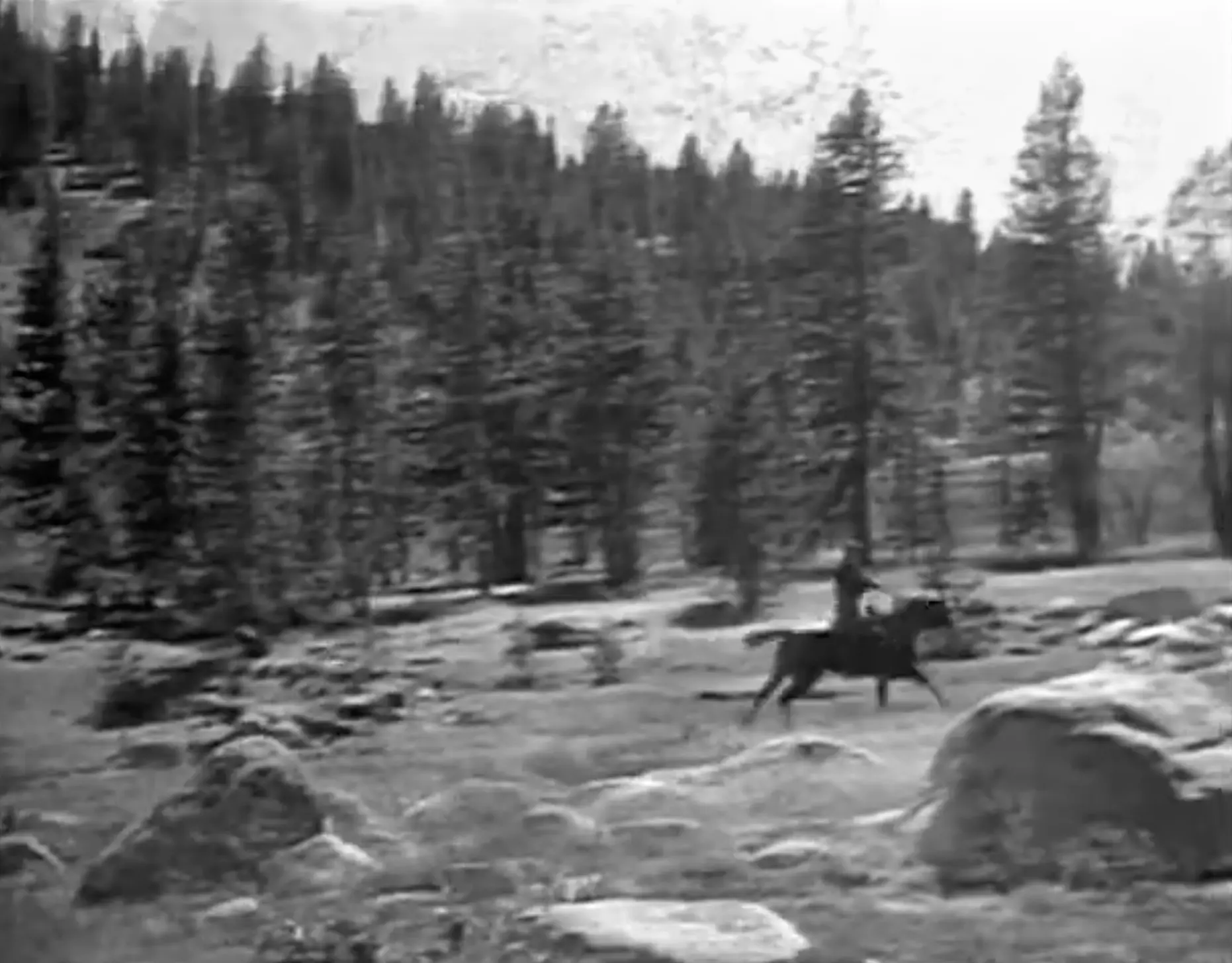
Riders of the Range (Lesley Selander, 1950)
Notes
Tom Stempel, ‘Tim Holt and the B Western’, Offscreen, November 2013 <https://offscreen.com/view/tim-holt-and-the-b-western>.
Ibid.
William Clare Roberts, Marx’s Inferno: The Political Theory of Capital (Princeton University Press, 2017), p. 149.
Phil Hardy, The Encyclopedia of Western Movies (Octopus Books, 1984), p. 104.
André Bazin, ‘The Western, or the American Film par excellence’, in What is Cinema?, vol. 2, ed. and trans. by Hugh Gray (University of California Press, 2005), 140–148 (p. 147).
Ibid., p. 145.
Nico Baumbach, ‘Nature Caught in the Act: On the Transformation of an Idea of Art in Early Cinema’, in Cinematicity in Media History, eds. by Jeffrey Geiger and Karin Littau (Edinburgh University Press, 2013), 107–116 (p. 113).
Ibid., p. 114.
Timothy Barnard, ‘Découpage’, in Montage, Découpage, Mise en Scène: Essays on Film Form (caboose, 2021), 73–164 (pp. 88–89).
Ibid., p. 91.
Stempel (2013).