The emergence of the motion picture camera in the late nineteenth century entailed a rethinking of the problem of realism that had animated aesthetic inquiry throughout that century. Fredric Jameson develops the concept of the ‘antinomies of realism’ to describe this problem, stressing the apparent incommensurability of realism, particularly literary realism, as an ethical imperative and aesthetic ideal, with its simultaneous demand for pictorial detail and narrative presentation. [1] For Jameson, this problematic also accounts for realism’s historicity, its antinomic relationship to the (post-)modernities of the present and thus to its own aims with regard to the history of forms. For us, the antinomies of realism mark the destiny to which the cinema is compulsively, yet unresolvedly, delivered. Cinema was informed by this destiny at its outset, as cinematic realism had at its disposal something beyond the reach of its literary cousin: what André Bazin called the ontology of the photographic image, the sense that cinema is innately predisposed to the capturing of empirical reality. Such was the basis for what the Lumières called their actualités, those units of realism at the origin of cinematic production. As the fulfillment of realism’s promise, cinema was understood as intervening in the struggle between the demands of telling and showing that plagued ‘realistic’ narrative representations of social texture. What André Malraux described as the novelist’s painstaking responsibility to choose ‘what is to become scene or to remain récit’ was to be diminished, if not displaced entirely, by the arrival of a medium congenital to the pictorial detail that so relentlessly interrupted the narrative diachrony entailed by the novel. [2]
Whether or not cinema successfully realized — or could ever realize — the promises of literary realism is secondary to the kind of questions opened up in the encounter between the cinema and the literary concerns that preceded its invention. The dispute regarding the possible homology between cinematic and linguistic structure does little to address questions which, haunted by literature’s strained relationship to history, pertain more to the affinity between fiction and demystification than to that between image and word. If both ‘image’ and ‘word’ can be understood as belonging to a grammar and to a technical apparatus accessible to craft, the more pointed question of demystification bears not only on the functional efficacy but, in a more complicated way, on the ethos of a work of fiction that would refuse to abandon the demands of the real. Thought rigorously with regard to its antecedents in literary realism, cinema should expand rather than close off the question of how fiction might assume its separation from empirical reality while still attending to the real in accordance with the demystificatory ethos of realism.
The contemporary dogma of realism maintains the immediacy and intelligibility of spectatorial experience, however much these ideals can seem undermined by this or that instance of formalism at work. This dogma manifests in the rhetoric of ‘believability’, ‘immersion’, and ‘world-building’ or, on the other hand, in the kind of festival-ready filmmaking that uses the pseudo-Bazinian markers of the long take and static shot to produce what Sam Warren Miell incisively describes as an ‘ersatz for materialism and “objectivity”’. [3] It is in this context that the films of Alain Guiraudie are exceptional, bearing the traces of classical mise en scène but approaching a narrative real that is neither empirically intelligible nor in need of the uncovering implied by a standard realist conception of demystification. Guiraudie’s films restore the sense in which cinematic classicism harbors the secret of its subversion not in any encoded form but in the very problems of fiction it sets out to assert and address.

The Zone of Interest (Jonathan Glazer, 2023)
These questions appear in Guiraudie’s oeuvre as early as 2001, with the twin works Du soleil pour les gueux and Ce vieux rêve qui bouge. The films are bold condensations of Guiraudie’s experiments with narrative realism: both occur in pastoral settings and tell tales of seduction in which the positions of desiring subject and erotic object are ambiguous (this dynamic, a source of both great intrigue and terror in Guiraudie’s films, is what he calls ‘[un] jeu de la circulation du désire’ in an interview with Criterion). [4] In these films, formal showiness is rejected in favor of an elaboration of environment, character, and world that avoids ‘believability’ or even ready intelligibility. The kinds of worlds we experience in Guiraudie’s films are close to those of the folk tales that the films’ pastoral settings evoke, tales that declare their fabular status without any cautious turns to reflexivity. In their similar tendencies to gather and advance unreservedly fictional elements, one might also see in Guiraudie’s work the traces of Kafka’s fictions. For example, Guiraudie’s Ce vieux rêve shares with Kafka’s ‘In the Penal Colony’ the central figure of a fictional machine whose workings are detailed in an equally thorough and ridiculous fashion. Such blithe textual inventions are common in Guiraudie’s films: Du soleil, for instance, features a mysterious flock of animals called ounayes, in search of which the protagonist sets off with a shepherd she happens to encounter and eventually have sex with.
Synoptic descriptions of Guiraudie’s films may well suggest affective intensities that are in fact barely registered in the films themselves. The climate of seduction that pervades Ce vieux rêve, for example, is not given at the outset as a mood but is rather assembled between scenes in a manner that is not straightforwardly progressive but gradual to the point of near-imperceptibility. If we are surprised to find the film’s protagonist, a young technician, reaching to unzip the pants of the older, balding factory manager who hired him, it is primarily because this gesture is performed so unconcernedly, without the quivering of either body or camera that might characterize the same situation in another film. This nonchalance imbues the manager’s subsequent rejection of the protagonist’s sexual advances or, for that matter, the protagonist’s rejection of another worker’s advances near the end of the film. ‘Je me connais,’ the protagonist asserts to the man who rejected him earlier, ‘je ne t’oublierai pas’; and, though this can be read as defiant or equanimous, we might take it instead as a disinterested expression of that fidelity Guiraudie’s fictions maintain to their process of assemblage, the dispassionate passions of a narrative unwilling to concede its own premises.
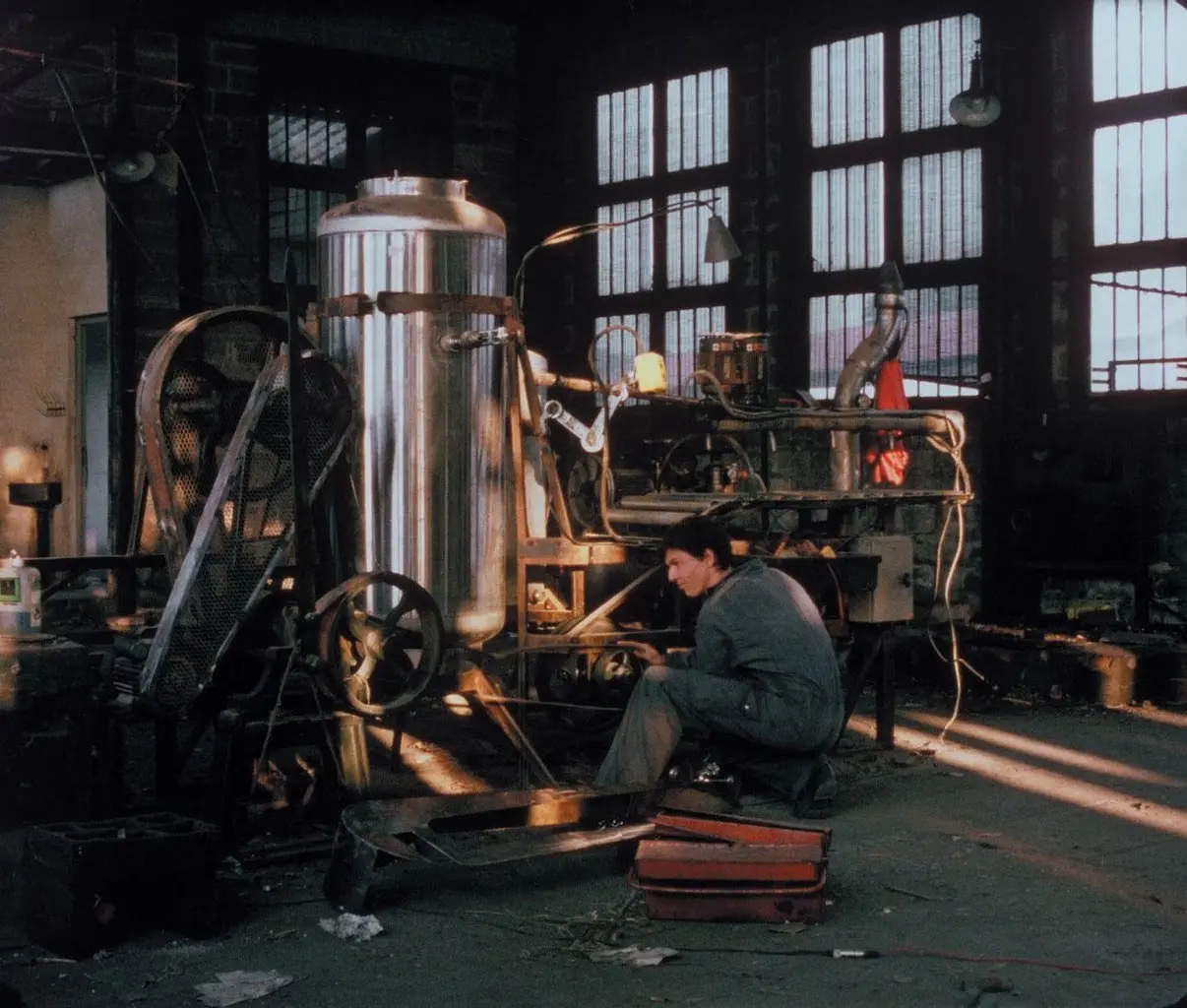
Ce vieux rêve qui bouge (Alain Guiraudie, 2001)
If Guiraudie’s characters are definable, it is not by means of psychological naturalism but by the bluntness of motive, occupation, and will. The plots in which these characters are installed remain peregrinations, loose but exhaustive, and often seem to exemplify the barest forms of narrative construction possible. It would be wrong to attribute this starkness to a delusory flight from reality; Guiraudie’s films instead employ these elementary gestures in order to heighten the contradiction between fiction and reality itself and arrive at another conception of the real — a narrative real that can be located in the elementary fictional gesture itself, what Paul de Man calls the positing act (Setzen) that initiates fiction and ‘separates fiction from the world of empirical reality’. [5] If critics have most strongly associated Guiraudie’s films with a thematic enactment of certain Freudian motifs (especially that of a perverse melding of Eros and Thanatos), it is because they are fundamentally oneiric, though not in the sense of being loudly concealed in meaning, like a dream ripe for analytic interpretation. The oneirism of Guiraudie’s films is related first and foremost to the rudimentary narratological motion of a fiction willing itself into existence through a series of arbitrary gestures, and weaving this series of positing acts through a movement that is always irregular with regard to its originary thrust. Like a dream, Guiraudie’s films are both erratic and motivated, agitated and yet casually recounted; it makes sense, then, that if a dream appears in the content of Guiraudie’s films, it is not represented pictorially but instead through its telling, as in the beginning of Pas de repos pour les braves (2003), in which a young man recites a foreboding dream to his bewildered friend.
Guiraudie’s most recent film, Miséricorde (2024), is in some respects the most successful of his experiments in narrative realism. The film is stripped of all stylistic pretension, exhibiting Guiraudie’s facility with classical cinematic grammar more distinctly than in any other of his films. Lengthy sequences of measured dialogue, efficient techniques of découpage, and a predominant focus on actors’ faces drive a narrative that is stunningly religious not only in thematic content but also in form. The story is itself quite simple: a man’s murder of another man generates a guilt that must be rectified, and this rectification ultimately occurs not through the legal realm of practical justice but through the redeeming love of another — in this case, strangely and quite movingly, through the sexual love of a priest. This narrative movement towards redemption is not simple or explicable; it instead depends on the positing of a wild, inexplicable, and miraculously unexplained relation between characters that remains moldable by narrative means. The characters maintain an unquestioned fidelity to these causal gaps that exist between them; concurrently, the film’s modest surfaces bear the tremors of a narrative willing to exhaust its impulses and assert the void in which it was first asserted. In Guiraudie, as in much cinema inflected by the grammar of classical cinema, the narrative real exists at the far end of narrative form, where fiction is inaugurated by the plainest of gestures and narrative follows suit, enjoying its existence in the gap that separates fiction from the illusory plenitude of empirical reality.
Paul de Man’s conception of fiction as the ‘only form of language free from the fallacy of unmediated expression’ is a precise way to describe what Alain Guiraudie’s oeuvre attends to: a real that does not present itself as unmediated but participates in its own production, including in the evasions and narrative arabesques that circumlocute its (non-)existence. [6] Guiraudie’s work refuses to ground itself in the 'immersive’ and ‘immediate’ conception of realism but, most impressively, refuses to ground itself in the metatextual play of more overtly demystificatory and self-reflexive filmmaking. What is genuinely reflexive in Guiraudie’s films is their ability to play themselves out, so to speak, and arrive at an initially unaccountable point of departure: the positing act (Setzen) that stands at the heart of narrative itself.
A genuinely critical conception of film ought to address the noxious proliferation of dogmatic discourses on realism without renouncing the film’s right to the real. Though film’s realist vocation may seem fatally plagued by the antinomies of realism, it is possible to see in classical cinema and its relationship to literary realism a prehistory that could function as a guiding thread for critical inquiry of realist cinema. And though it may seem to be totally subsumed by its appropriation for blind industrial use, a medium as new and yet as anticipated in the history of forms as cinema continues to be radically well-suited to provide the tools for the future of its own inquiry. The extraordinary excursions of Alain Guiraudie stand as testament to this. Few working filmmakers enjoy a narrative yarn like Guiraudie does, and few filmmakers so deftly render this enjoyment an ethics of the film itself — an incontrovertibly political gesture, since the sliding of subject positions, that faded line between fucking or getting fucked, remains, for the spectator as for Guiraudie’s characters, relentless, arousing, and inexorably tied to forces of guilt, excuse, redemption, and homicidal rage that unground our understanding of what it means to live with others. Guiraudie, for whom rumors of love are always true but never incontestable, comes from a narrative lineage that is both sacrilegious and sweet: twisted materialist fables, like those of Kafka or Buñuel or Chabrol, that stay pervious to the limits of the will. These are fictions that, having reached the end of their pursuits, find desire where the scaffold of narrative once stood.
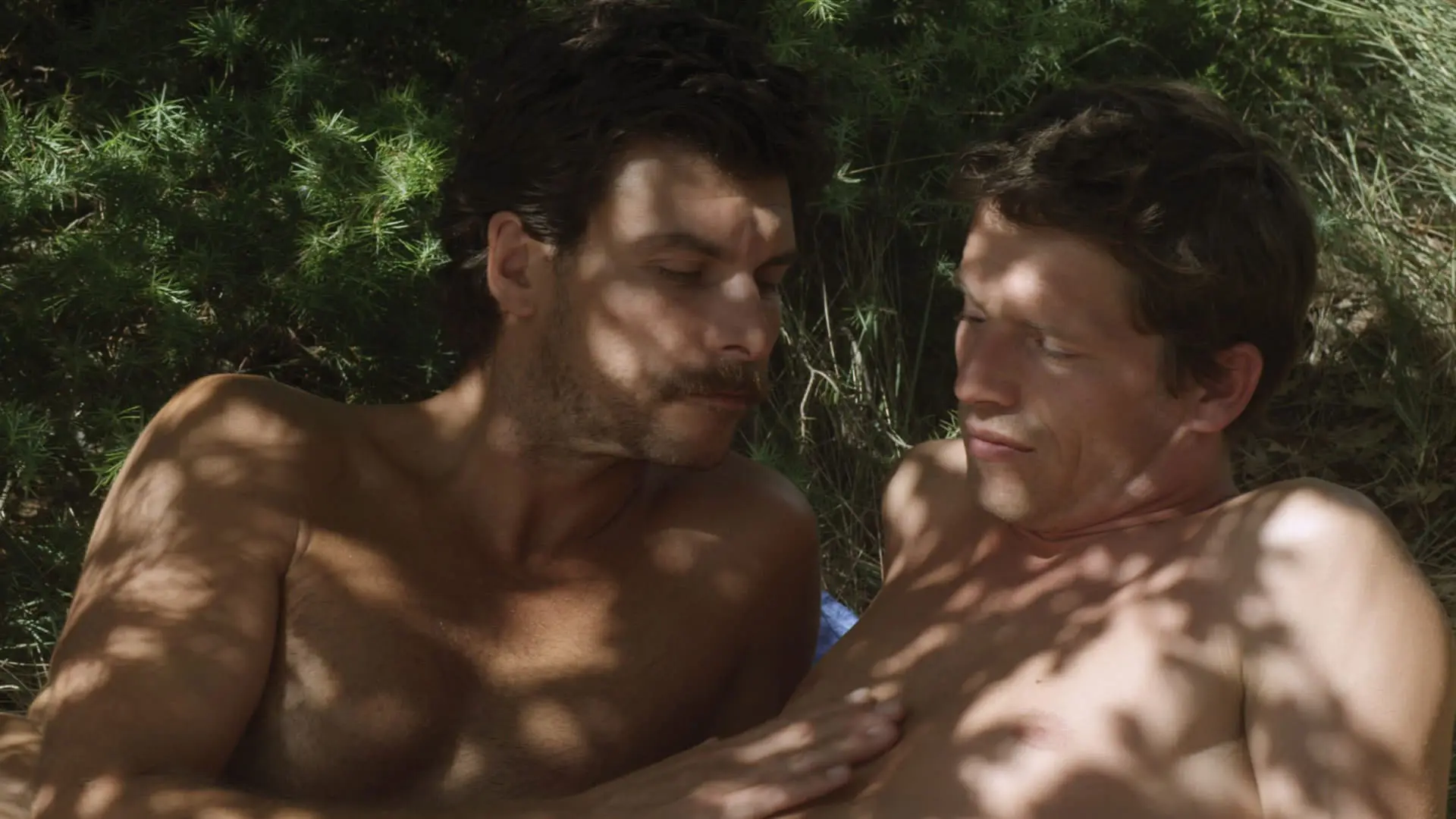
L'Inconnu du lac (Alain Guiraudie, 2013)
Notes
Fredric Jameson, The Antinomies of Realism (Verso, 2013).
André Malraux, Les voix du silence (Gallimard, 1951), p. 333; quoted and translated by Jameson, p. 22.
Sam Warren Miell, ‘The Static Shot in The Zone of Interest’, available at https://medium.com/@samwarrenmiell/the-static-shot-in-the-zone-of-interest-f50571f35485.
Alain Guiraudie, interview on Criterion Channel, 2024, https://www.criterionchannel.com/videos/alain-guiraudie-interview.
Paul de Man, ‘The Rhetoric of Temporality’, in Blindness and Insight: Essays in the Rhetoric of
Paul de Man, ‘Criticism and Crisis’, in Blindness and Insight, 3–19 (p.17).