From: Paul Vecchiali
Date: 1 Dec 2022, 06:29
Subject: BLL
A change of programme: 09:50 am SHARP, instead of 10:00 am, still 3rd December. Each of you may bring one friend. I look forward to seeing you and showing you the last (?) opus. Best wishes to you all. Paul.
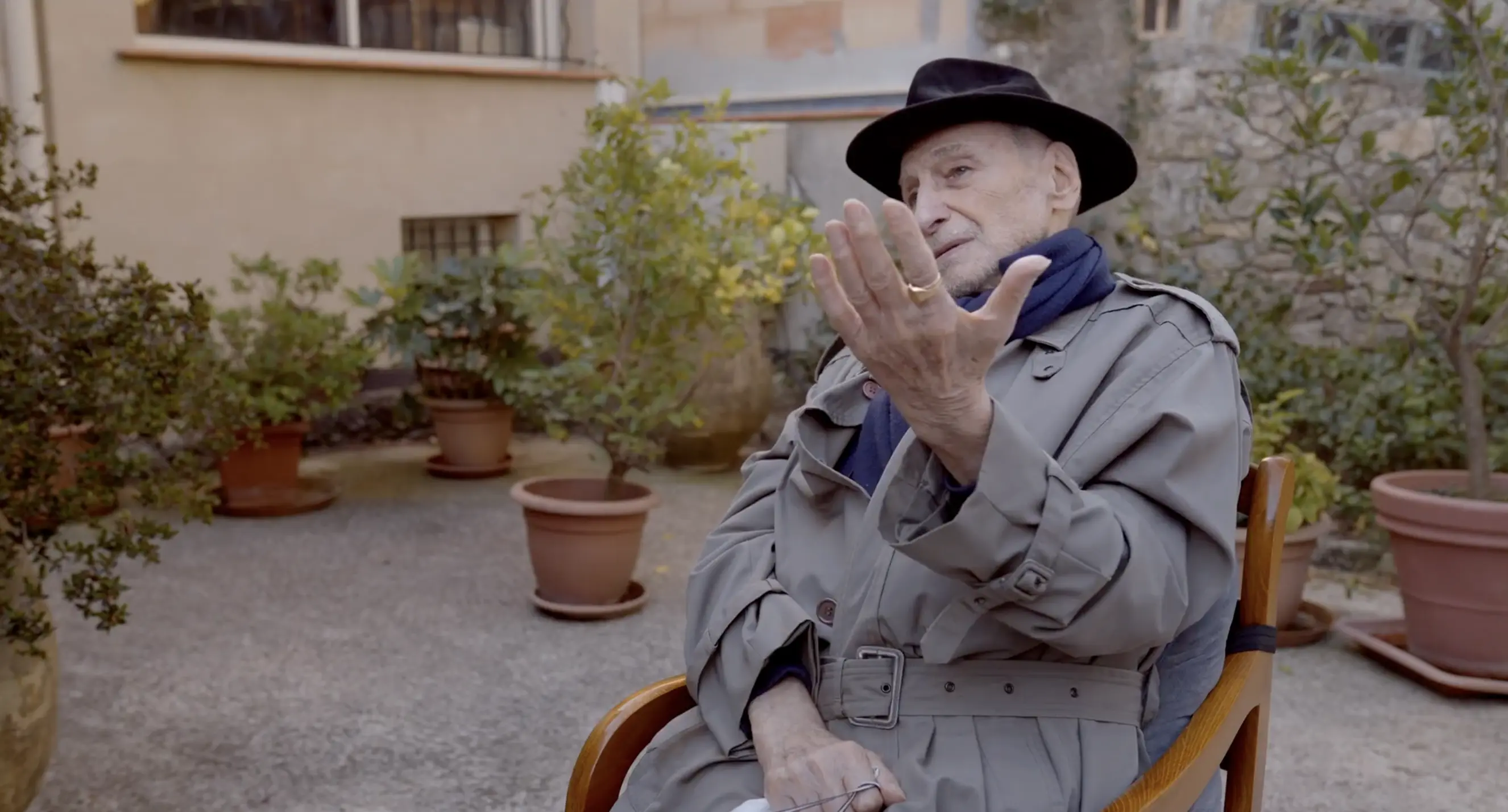
Bonjour la langue (Paul Vecchiali, 2023)
It is December 2022, and Paul is presenting a private screening of Bonjour la langue at the Grand Action cinema in Paris. As I recall, he didn’t say then that he had shot the film in one day, completely improvised. Maybe he did say it, but I don’t remember him doing so, as that’s not what I wrote in my letter sent two days later, on 5th December.
—P.B.
From: Pascale Bodet
To: Paul Vecchiali
Date: 5 Dec 2022, 11:43
Subject: RE:BLL
Dear Paul,
Before the screening you said — and this was strange — that you welcomed remarks or suggestions from viewers of Bonjour la langue because you were not sure. That was very strange, because you’re usually so sure. And then you invited us, before the screening, to take a pencil and paper.
Before the film, I took a piece of paper and a pencil.
Then I put the pencil and paper down and didn’t think about them again.
And I don’t know where to begin. So I’ll begin in order, according to my impressions.
In the courtyard, everything seems written, planned out. Correspondent découpage: we progress closer to both of you, you/father, Pascal/son. [1] The playful father, playing the game of truth, finds himself a little bit dominated, ha ha, by the son because of his fatherly bad faith. But the level of contradiction between father and son is sufficiently elevated that this increasingly contested game flies high. It achieves, in moments, fragments of extraordinary sincerity, such as when you speak of death that approaches and is already there, and when you use this word ‘helpless’ [paumé]: you find yourself ‘helpless’ as death approaches. ‘I call people on their phone numbers and no one is at the end of the line, the dead can’t be reached’: this is the antechamber. Your son stands in front of you, the game of truth is prolonged, becomes more precise, the frames narrow, no fat.
Second part: the restaurant. It’s another regime now. There are no longer those narrow framings which provided the dramaturgy of the first part, which made it seem written. The characters are now sat opposite each other in the most ‘uninteresting’ of mundane settings, the truth game continues in real time. There is no more of this marvelous ‘off’ from the first part (for example when the son recites the father’s poem ‘off’ and we see the father’s face). [2] The banality of a meal with the characters relaxing. An interminable shot/reverse shot without any ‘off’ and thus without latency, the mechanics of an ‘in’ on the characters ‘in relaxation’ (indeed, actors so at ease that one wonders whether they are acting at all), which leads up to a point of no return, to a climax-keystone-that-couldn’t-be-more-derisory: the tomato-peach. [3] Extraordinary tomato-peach… Listing favourite deserts, staking a claim to have invented a dish (the tomato-peach) that could — if only the son had tasted it, known it — have contributed to the immaterial familial patrimony [...]. [4]
After that point, the film flopped. [5] I didn’t listen to anything anymore, it was proceeding too much in real time.
You invited us to give our advice, so I’m going to propose a big cut to you, and forgive me if this big cut I’m proposing has fuzzy boundaries (I didn’t take notes during the screening, I dropped my pencil and paper, as I said). This big cut corresponds to a passage of around fifteen, or twenty (??) minutes, concerning Covid, the mother and your exploits with her [...]. [6] NB I hope that this big cut, if made, would retain the ‘crème brûlée’ effect: we have the impression that there are 3kg of crème brûlée to eat during the shot/reverse shot, and I loved the impression that you would eat crème brûlée for as long as the conversation lasted, independent of the actual size of the desert [...]. [7] I do love the real time effect, with this feeling that the film is resting, relaxing, making the smallest everyday detail into a moment that not only must be shared in the story, but also must test the limits of the rules set by the film itself (those of a game of truth that wallows in the truth of real time, in life without art, I don’t know how else to put it). But I still propose that you make a big cut [...]. [8]
The end. Nothing more to say. Except to note the extraordinary sensation of a sole two shot and ‘true’ real time: now it is no longer the real time of an uninteresting mundane setting (or of life without art), but the real time of fiction — fiction in real time! Which is emotion. Three parts, [9] three diets — three regimes of nourishment: drama, chronicle, [10] tragedy (or melodrama) (tragedy if one judges that there was a first abandonment) (melodrama if one has the impression of a twist of fate hidden up the father’s sleeve), and in this third part, we reach a point B of emotion. Because in your film, we had already experienced point A.
The flashbacks make me cry. The prologue too, obviously. Are you talking about Godard? Are you talking about a lover? Who is that man you see, between the sea and the sheet? Well, it’s your son! These flashbacks make me cry because they give me the emotion of time passing, of memory. They’re nostalgic, a bit sentimental and soapy, and that’s the point A of emotion. It’s this emotion A that I also felt in the credits: at the beginning with respect to your face, blurred and masked, as if already dead; at the end, in the crushed ovals of iridescent colour, your hat, which made me think of Father Guitry — of Lucien Guitry, in the shot from Ceux de chez nous (1915) — how time flies.
And then, in the third part, there is a point B of emotion, an emotion which is not nostalgic, not soapy, not easy, but an emotion-abyss, a transfixing emotion [l’émotion sur-place], an emotion like facing death: that emotion in the face of which we find ourselves helpless. [11] In the game of truth, it is no longer possible to put up a front, to make little jokes, to throw out retorts, to keep chattering. You have just told your son that he was adopted. He takes it. He doesn’t know what to say.
There is a bit I love in this ending: you say ‘I have no regrets’, then ‘I have many regrets’; you say ‘Your sister knew’, then ‘Your sister had no idea’. But the contradiction here is no longer the same as at the beginning (where it was between two people who contradict each other). At this point in the film, you contradict yourself, in a big way, and the son doesn’t even bring it up afterwards. He is in shock. The contradiction is taken up a level: the contradiction no longer lies in what is being said, but rather in the shock of what has just been said and is now being felt. The son is in shock: ‘But Dad, why are you telling me this, that I am an adopted child and you are not my father?’ Here is his emotion. The end of the film allows us to access his emotion. [12]
And what I liked most in Bonjour la langue, in this three-part journey with its word traps and its game of truth that began right from the start, is that the most important thing is not stated, is not formulated, and that’s why I found your film magnificent: the son does not say what’s staring him in the face. He says: ‘Oh, I feel betrayed because my sister knew’. He says: ‘Oh, but the thing is, dear Dad, you’ve lied to me all these years.’ He says: ‘Oh, I can’t feel things and speak at the same time.’ What he does not say is: if I am an adopted child, that means that I am, first and foremost, an abandoned child. What’s really crazy is that he doesn’t say what’s right in front of his nose!!! I WAS ABANDONED! AS A CHILD, THE FIRST THING THAT HAPPENED TO ME WAS THAT I WAS ABANDONED. OH, BIOLOGICAL PARENTS, WHY HAVE YOU ABANDONED ME?
So yes: ‘Bonjour la langue’, with same kind of intonation as one says: ‘Well then, hello holidays’ (when the holidays are completely ruined), ‘Hello bourguignon’ (when it is burnt, inedible), or ‘Hello vocabulary’ (when the chosen vocabulary is not at all suitable for the occasion). So: ‘Hello language!’, yeah! Here, the son expresses himself by saying nothing. ‘Hello language!’ In the first part, the son speaks about his feeling of having been abandoned at age 6 or 7. His father contradicts him: ‘No, it’s me who has felt abandoned since the death of your mother and your sister.’ And then, in the third part, the son doesn’t say a word about the real, principal abandonment. This is exactly what I love and admire in your film: at the end of a process of nonstop chatter, chatter which spreads out into the most mundane–futile conversations you can think of, the son doesn’t say anything else.
A vast story of abandonment. A vast story of abandonments, said, then unsaid — implied, implicit.
I’m flabbergasted: you! 93 years! And another astonishing thing! Something totally new! Something that renews as much as it deepens your previous films. I don’t know how you do it. Bonjour la langue, as you explained to me on the phone, is an idiom [une langue en soi], not ‘a language [un langage]’ (not what we could call the ‘Vecchialian language’). An idiom that is deployed from beginning to end, and which evolves, exhausts itself, and transforms, and in three blows delivers a theory of cinema at the same time as it recounts a final day between a father and a son.
I also think the film is a very beautiful gift to Pascal, a marvelous portrait of him, I’ve never seen him look so much like himself.
Bonjour la langue goes very far, already with one foot in the grave and catching up with death, but compared to 7 Déserteurs, which has its nose in the grass, Bonjour la parole makes the ultimate ordeal that will soon be all of ours more bearable, by inventing a son for you. The film has its cheerfulness, and I thank you for making a living film of the coming of death.
So, thank you, Paul.
I send you my warmest regards, and to Malik too.
Pascale
From: Paul Vecchiali
To: Pascale Bodet
Date: 5 Dec 2022, 20:33
Subject: RE: BLL
I thank you for your long, very long commentary. You’re all over the place as usual because you reflect while watching the film, and, on that point, we will NEVER agree. [13] Proof of this is the third sequence, which is CRUCIAL for me because it expresses definitive reconciliation, jokes and shared laughter. An INDESPENSABLE sort of [14] ending to the film, if you’ll excuse me. So much so that when he [Pascal] came to help me up, [15] I thought: the film is finished. It was then and only then that the idea of adoption came to me. In short, it would take hours to talk about the ‘lies’ and ‘memory lapses’ [les oublis], apparent contradictions which are, in fact, characteristic of old people (lies or memory lapses THAT IS…). [16] We didn’t watch the same film. I have things to review (since I had never seen it before the screening), but they are details (color grading, too fast of an opening), there being no reverse shot on Pascal after he drops his bag, pieces of music (excepting the last) that should not be film music but rather musical ‘jolts’ in the old man’s head ETC. Kisses
From: Pascale Bodet
To: Paul Vecchiali
Date: 5 Dec 2022, 20:51
Subject: RE: BLL
Ah no Paul you must make a cut in the restaurant !!!
And you continue to tell me that we will never agree, so yes, maybe. OK, but it annoys me. Your details, OK. For me, it’s not a question of details, not at all. Clearly I wrote everything I wrote to you for nothing.
I don’t care about the details.
My email was perhaps too long.
The main thing is: I love your film, overall and specifically.
Kisses to you and Malik
From: Paul Vecchiali
To: Pascale Bodet
Date: 5 Dec 2022, 22:52
Subject: RE: BLL
I didn’t mean to upset you. I still maintain that cutting an improvised film is an insult to the actors (amongst other arguments). Best wishes. Paul
From: Pascale Bodet
To: Paul Vecchiali
Date: 6 Dec 2022, 10:38
Subject: RE: BLL
I’m not upset, I was just annoyed yesterday, we don’t agree that’s all.
Well, I send you my love
Pascale
* * *
Emmanuel Levaufre tells me that it’s sad, as an end to our correspondence, but I don’t find it sad, we always wrote to each other like that. I wrote at length and he wrote laconically. We wrote to each other to send our best wishes, and about his films, or a little bit about mine (he liked some, others not). I met Paul in 1997 on the set of Victor Schoelcher, l’abolition (1998), where he had invited me. Since then, we wrote to each other and saw each other, never often, but episodically, and over a long period of time. He used to call me ‘the smiling Madame Beudet’, after the title of a film from the twenties that I’ve never seen. [17]
In December 2022, I saw Bonjour la langue for the first time, and the first viewing always plunges one into the most extreme vigilance, with attendant aberrations.
Since then, the film has been released, presented as a ‘film shot in one day, completely improvised, filmed with two cameras, and edited in a way that completely respects the improvisation’.
I wasn’t the only one who thought that the sequence in the restaurant was too long (according to Pascal Cervo, several viewers had suggested to Paul that it be shortened). But my suggested cut was, on reflection, absurd.
Not because I didn’t realise that the film was entirely improvised, that it was filmed with two cameras, and that the 1 hour and 20 minutes of improvisation had resulted in 1 hour and 20 minutes of film.
Not because Emmanuel Levaufre has written to me that ‘I find Bonjour la langue to be very well constructed, with a simple, mirrored structure (since the dramaturgical function of the découpage is inverted in the second part), with a cesura in the middle of the restaurant sequence — which is why I think that Vecchiali was right not to make the cut you advised.’
But because it was my impulse as a viewer.
Because I hadn’t thought it through.
For his final film, Vecchiali made a gesture and a film correspond, without touching it up.
He made the real time of a filmed improvisation coincide with a finished fiction film.
He mixed up life and cinema — as had been his vow (since many films already).
It was his last gamble.
So I was wrong.
—P.B.
Notes
‘Pascal’ for Pascal Cervo, who plays the son. [All footnotes are by Pascale Bodet unless otherwise noted. - Trans.]
I have since learned that this ‘off’ from the first part was due to a filming accident: the camera that was shooting Cervo recite the poem glitched. Vecchiali liked to play with filming accidents. Seeing an image of the father while listening to the son recite the poem offscreen is even more beautiful.
Pascal Cervo speaks very well of the pitfall of improvisation, which he feared and had been forewarned about: filling space with meaningless blather.
I cut a bit here because I no longer understand what I wrote.
Translator’s note: That is, up to the end of the ‘second part’.
Idem.
I’m keeping this passage even if it’s difficult to understand. What I meant to say was: thanks to the shot/reverse shot (and I remind you that the improvisation was filmed with two cameras), we get the impression, in passing from one character to another, that the eating of this crème brûlée is infinite. In general, cinema is an art of ellipsis. Here, the shot/reverse shot doubles the time it takes for the two characters to eat a crème brûlée, as if it were eaten twice: in the shot, and in the reverse shot. Referring to the shot/reverse shot in front of the pharmacy in Corps à cœur, Vecchiali said: ‘I absolutely did not want to polish the sound with a track of room sound that makes it possible to camouflage the changes in shots. We pass from one shot to another without the model of the mixing that you find in classic films. In the continuation of the sequence, when she [Hélène Surgère] joins [Nicolas] Silberg at his car, I left the sound CUT for the shot/reverse shot. Tac tac. Here we find the idea of the change of shot as an ellipsis.’ ‘Le branle des évidences (2)’, La Lettre du cinéma, 19, Winter 2002, 20–55 (p. 35).
My idea was thus: 1kg of anti-dramatic insignificance, that’s good; 3kg, why not?; but 10kg, that’s too much. And I also saw the waiter in the sequence, sometimes onscreen, sometimes off, as something that disturbed real time, and was thus exogenous to the insignificance of real time.
In presenting the film on the occasion of its general release on 27 August 2025, Pascal Cervo spoke of ‘acts’, rather than ‘parts’. Emmanuel Levaufre, with whom I conducted a very long interview with Vecchiali that was published in 2002 in La Lettre du cinéma, wrote to me that he did not understand my construction: ‘I was surprised by the message that you sent to Paul. I did not see the same construction as you. You said that there are three parts. That’s true if we stick to the sets. But to me the film is rather divided in two parts, with each part then containing two sub-parts. That gives us: I. a. Shot/reverse shots in the courtyard (classical dramaturgy: from conflict to reconciliation). I. b. Two shot in the restaurant (calm conversation, coda to the previous part). II. a. Shot/reverse shots in the restaurant (return to a “dramatic” découpage, but in the frame of a calm conversation). II. b. Final two shot (return to conflict but in the frame of non-dramatic découpage: the extreme violence of “Talk to me, for God’s sake!”, in contrast with the découpage). This last sub-part is also the one where the bodies of the actors touch. And between each of these sub-parts: the clips from Le Cancre (2016), which are like chasms, like “memory lapses [trous de mémoire]” (which could also have been the title of this film).’
Emmanuel Levaufre prefers ‘anti-drama’ to ‘chronicle’, and I think he’s right.
‘Emotion-action’? An audience member at the screening at the Grand Action on 31 August 2025 remarked that the first time the father/Vecchiali cries in the first part, the actor (Vecchiali) performs a courageous act: he starts crying, even though there are no tears. It’s a blank, dry act. In a similar vein, when the father/Vecchiali blurts out ‘You are not my son’ to launch the third part, it’s performative language: this is an act from the point of view of speech.
Pascal Cervo said that what Vecchiali filmed in Bonjour la langue was more a ‘relation’ than a dialogue.
For years, Paul reproached me for analysing films at the same time as I felt them. That irritated him. But seeing as he directed ‘the thing and the critique of the thing’, I felt I was in tune with his cinema (that being said, I have this ‘double vision’ for any film).
I am not sure if Paul intended to write ‘a kind of ending to the film’ [‘Une sorte de fin de film’] or ‘a fate at the end of the film’ [‘Un sort de fin de film’]. [Vecchiali’s original email reads: ‘Une sort de fin de film INDISPENSABLE’, meaning one must make a decision with respect to how to correct the inconsistency in his pairing of the article used for feminine nouns (‘Une’) with the masculine noun (‘sort’), assuming either that he has mistyped the former, or that he has mistyped the latter. - Trans.]
Translator’s note: Vecchiali here refers to the end of what Bodet has been calling the ‘second part’ of the film, where Pascal Cervo helps Vecchiali up from his restaurant seat. The fact that he refers to this as the end of the ‘third sequence’ could accord with Emmanuel Levaufre’s alternative breakdown of the film’s structure in footnote 9.
Translator’s note: ‘THAT IS’ is in English in the original correspondence.
Translator’s note: i.e. La Souriante Madame Beudet (1923).